Bring the mental model from Efficiency: Quantization, Distillation, LoRA & Sparse MoE; this page will reuse it instead of restarting from zero.
Pruning: Removing Unnecessary Weights
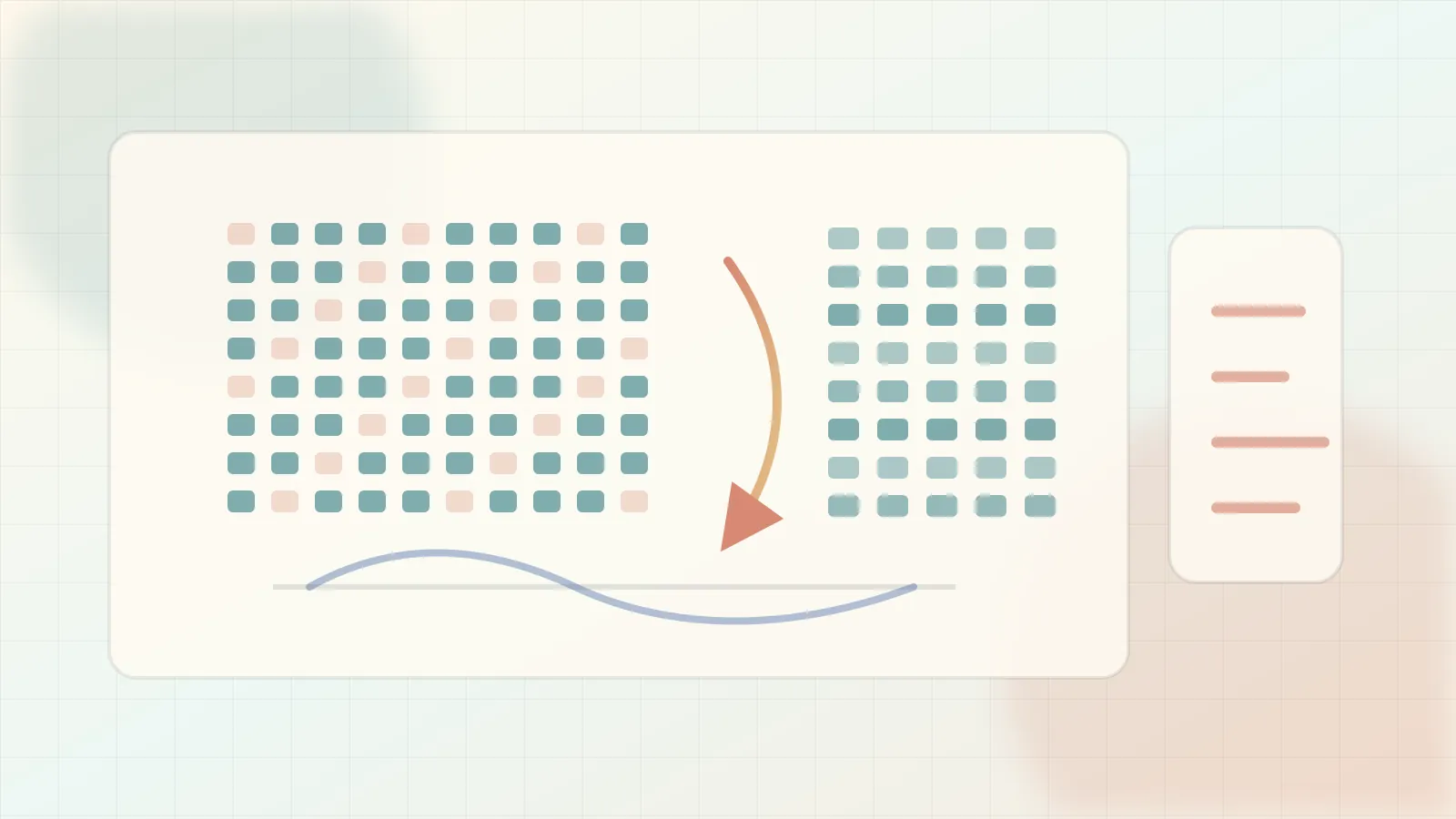
Reduce parameter count by zeroing or removing weights. Unstructured sparsity needs sparse kernels for speed; structured pruning removes whole channels/heads to shrink dense tensor shapes.
Intuition
Build the mental picture first so the rest of the page has something to attach to.
PredictName the object in plain language, then predict what should change.Leave with one reusable mental picture before notation appears.
Deep nets are often heavily overparameterized. Pruning asks: can we remove weights (or whole structures like neurons/heads) while keeping most of the performance?
Two big distinctions matter:
- Unstructured pruning: set individual weights to zero. This can give huge sparsity numbers, but you only get speedups if your hardware/software stack has sparse kernels.
- Structured pruning: remove whole channels/heads/blocks. This often gives smaller compression, but because it changes dense tensor shapes, it is more likely to translate into wall-clock speedups on standard kernels.
The surprising part is that naive rules (like "prune small weights") often work decently, even though they are not theoretically optimal.
Section prompt
Copy-only prompts — each action copies a page-grounded prompt to your clipboard. Nothing is sent by this site.
Math
Translate the story into symbols, assumptions, and a derivation you can inspect.
InspectTrack the same object through the notation and check each symbol.Leave with the invariant the equations preserve.
Equation 1Inspect equation objectM_{ij}=\mathbf 1[|W_{ij}|>\theta],\qquad W_{pruned}=W\odot M.Equation 2Inspect equation objectW_{pruned} = W[:, S].
Magnitude pruning (a common baseline)
Let be a weight matrix and let be a threshold. Define a mask:
Structured pruning (remove units)
If is the set of columns/heads you keep, structured pruning changes the layer shape:
This changes the model shape, which is why it can translate into ordinary dense-kernel speedups more directly.
Section prompt
Copy-only prompts — each action copies a page-grounded prompt to your clipboard. Nothing is sent by this site.
Code
Keep the implementation aligned with the notation so the algorithm is legible.
TraceMatch variables to symbols before reading the implementation.Leave with a runnable witness for the math.
import numpy as np

rng = np.random.default_rng(0)
W = rng.normal(size=(256, 256)).astype(np.float32)

sparsity = 0.7  # prune 70% of weights by magnitude
th = np.quantile(np.abs(W), sparsity)
M = (np.abs(W) > th).astype(np.float32)
W_pruned = W * M

print("target sparsity:", sparsity)
print("actual sparsity:", round(float((M == 0).mean()), 3))
print("L2 norm ratio ||W_pruned||/||W||:", round(float(np.linalg.norm(W_pruned) / np.linalg.norm(W)), 3))
Section prompt
Copy-only prompts — each action copies a page-grounded prompt to your clipboard. Nothing is sent by this site.
Interactive Demo
Use direct manipulation to connect the explanation to a moving system.
ManipulateChange one control and predict the visible response before reveal.Leave with the observed invariant or a repaired model.
Live Concept Demo
Explore Pruning: Removing Unnecessary Weights
The stage is code-native and interactive. Use it to test the explanation against the mechanism.
difficulty 3/5undergraduatecode-aligned
Demo inquiry checkpoint
Manipulate one control and predict the visible change.
Choose what to inspect in Pruning: Removing Unnecessary Weights. This shared fallback is an observation guide, not evidence of learning.
Loading interactive demo...
The demo below asks you to predict which pruning pattern actually turns into a speedup before revealing the mask and deployment metrics. The key invariant is that unstructured zeros reduce storage and sometimes sparse-kernel work, but structured pruning changes the dense matrix shape and therefore can map to ordinary GPU speedups more directly.
Section prompt
Copy-only prompts — each action copies a page-grounded prompt to your clipboard. Nothing is sent by this site.
4/4 sections ready
Concept: Pruning: Removing Unnecessary Weights
What is the smallest example that makes Pruning: Removing Unnecessary Weights click without losing the math?
BeforeEfficiency: Quantization, Distillation, LoRA & Sparse MoENow4/4 sections readyTryManipulate one control and predict the visible change.NextQuantization: Compressing Models to Integers
Object contextEfficiency
StateEfficiency
2 sources attachedChecking local snapshot
concept:efficiency/pruningConceptLearner lens
Pruning: Removing Unnecessary Weights
What is the smallest example that makes Pruning: Removing Unnecessary Weights click without losing the math?
Mode questionCan I say the mechanism back in one sentence before I reveal anything?
Start with the prediction checkpoint, then compare the reveal to the mental model.
Take this moveStudy modes
Keep the object fixed; change the lens.Route back through the notebook
Carry the same object through intuition, math, code, and demo.
Reduce parameter count by zeroing or removing weights. Unstructured sparsity needs sparse kernels for speed; structured pruning removes whole channels/heads to shrink dense tensor shapes.
The next edge should feel earned: use the demo prediction here before following Quantization: Compressing Models to Integers.
After The First Pass
Turn the concept into an inspected object.
The lower panels are one second act: keep the object fixed, inspect it visually, check source boundaries, practice transfer, then attach the research question.ConceptPruning: Removing Unnecessary WeightsEfficiency
01MechanismInspect motionSee how the idea changes form before adding more explanation.02VisualChoose a cueBind one visible mark to one mathematical role.03SourcesCheck boundary2 source links attached to the object.04ClaimAudit evidenceTreat the page claim as something to verify.05PracticeAttempt transferWrite before feedback so the model has something to repair.06RoomAsk groundedAttach the question to the same exact object.
Mechanism Storyboard
See the idea move before the page explains it
Reduce parameter count by zeroing or removing weights. Unstructured sparsity needs sparse kernels for speed; structured pruning removes whole channels/heads to shrink dense tensor shapes.
Demo notes open01 / Intuition
Prediction lens
Start with the picture, metaphor, or geometric mechanism.
Commit first
Before reading further, choose the kind of change Pruning: Removing Unnecessary Weights should make visible.
Visual Inquiry
Make the image answer a mathematical question
Reduce parameter count by zeroing or removing weights. Unstructured sparsity needs sparse kernels for speed; structured pruning removes whole channels/heads to shrink dense tensor shapes.
4/4 stages readyDemo notes connected
Visual cueWhich visible object should carry the first intuition?
Prediction
Which visible object should carry the first intuition?
Commit first
Pick the cue that should make Pruning: Removing Unnecessary Weights easier to reason about before the page gives the answer.
Source Grounding
Canonical references for the mechanism on this page.
Object - ConceptPruning: Removing Unnecessary WeightsQuestion
What is the smallest example that makes Pruning: Removing Unnecessary Weights click without losing the math?
concept:efficiency/pruningsources: han-2015-deep-compression, li-2016-pruning-filters
Open the closest source note before trusting the local explanation.
2 selected-object sources shown first; 2 references total.
Audit the claim boundary, then ask from the same selected object.
Located CF editorial boundary
Grounds magnitude-threshold connection pruning, retraining, sparse storage, and sparse-kernel batch-1 speed/energy benchmarks in the Deep Compression pipeline.
Used here as
Han et al. prune small-weight connections below a threshold, retrain remaining sparse connections, store them as CSR/CSC, and benchmark sparse matrix-vector kernels. Li et al. show filter...
Caveat
This checks the pruning-mask and deployment-distinction lesson, not exact compression ratios, full retraining schedules, measured speedups, modern pruning methods, sparse-kernel performan...
Located CF editorial boundary
Grounds structured/filter pruning as removing whole filters and feature maps, avoiding irregular sparse connectivity, and mapping to standard dense BLAS operations.
Used here as
Han et al. prune small-weight connections below a threshold, retrain remaining sparse connections, store them as CSR/CSC, and benchmark sparse matrix-vector kernels. Li et al. show filter...
Caveat
This checks the pruning-mask and deployment-distinction lesson, not exact compression ratios, full retraining schedules, measured speedups, modern pruning methods, sparse-kernel performan...
Claim Review
Reduce parameter count by zeroing or removing weights. Unstructured sparsity needs sparse kernels for speed; structured pruning removes whole channels/heads to shrink dense tensor shapes.
Object - ConceptPruning: Removing Unnecessary WeightsQuestion
What is the smallest example that makes Pruning: Removing Unnecessary Weights click without losing the math?
concept:efficiency/pruningsources: han-2015-deep-compression, li-2016-pruning-filters
Treat every claim as provisional until source support and a local witness agree.
1 structured claim check on this concept.
Run the prediction or practice transfer before asking for a grounded review.
1 CF editorial source-scope review recorded
Publisher-side editorial review is not independent replication. Claims without it still need exact source-support review. 2 references and 3 local witnesses are available for inspection.
Registered CF editorial boundary
Deep Compression: Compressing Deep Neural Networks with Pruning, Trained Quantization and Huffman CodingGrounds magnitude-threshold connection pruning, retraining, sparse storage, and sparse-kernel batch-1 speed/energy benchmarks in the Deep Compressi...Pruning Filters for Efficient ConvNetsGrounds structured/filter pruning as removing whole filters and feature maps, avoiding irregular sparse connectivity, and mapping to standard dense...
Used here as
Han et al. prune small-weight connections below a threshold, retrain remaining sparse connections, store them as CSR/CSC, and benchmark sparse matrix-vector kernels. Li et al. show filter pruning removes who...
Local witnessEquation 1 Equation 2 Code witness 1import numpy as np rng = np.random.default_rng(0) W = rng.normal(size=(256, 256)).astype(np.f...
source-span-han-2015-deep-compressionsource-span-li-2016-pruning-filtersmath-object-1math-object-2code-witness-1interactive-demo
Caveat
This checks the pruning-mask and deployment-distinction lesson, not exact compression ratios, full retraining schedules, measured speedups, modern pruning methods, sparse-kernel performance on current hardwa...
Review stateCF editorial source-scope reviewClaim metadata: source checkedPublisher-side editorial review only; not independent replication. Check caveats and exact source scope.
Oracle PASS: Han supports thresholded unstructured connection pruning, masks, CSR/CSC sparse storage, and sparse-kernel benchmarking; Li supports filter/feature-map removal that avoids irregular sparsity and maps to smaller dense BLAS operations. Scope excludes exact ratios, schedules, modern hardware, universal speedups, and accuracy guarantees.
Reviewer: codex+oracle; reviewed 2026-05-07Practice · Pruning: Removing Unnecessary Weights
Try the idea in your own words
Reduce parameter count by zeroing or removing weights. Unstructured sparsity needs sparse kernels for speed; structured pruning removes whole channels/heads to shrink dense tensor shapes.
Concept · Current object
Pruning: Removing Unnecessary Weights
Source boundary: sources: han-2015-deep-compression, li-2016-pruning-filters
Object context and links
Efficiency
concept:efficiency/pruningExplain the mechanism
For Pruning: Removing Unnecessary Weights: What is the smallest example that makes Pruning: Removing Unnecessary Weights click without losing the math? Explain your answer, including what changes, why, and which assumption matters.
No answer yet
A rough first thought is enough. Your draft stays when you change tasks.
Local to this page session. Not saved after leaving or reloading.
A little help · Explain
Open one hint at a time. These are suggestions, not your answer or a grade.
0 of 3 hints shown for this question.
Clearing your answer does not erase help history. Outside help cannot be verified here.
Where am I stuck? (optional)
Take your draft to a feedback conversation
No AI feedback runs here. You can copy a prompt to use elsewhere; nothing is sent automatically. Review the text before sharing, and leave out private information.
Write an attempt before copying a feedback prompt.
This draft and any AI response do not establish mastery. Try a different case later without help; this page has not measured that learning.
Grounded object roomClose
Selected object routeAsk from this object; carry one invariant back.sources: han-2015-deep-compression, li-2016-pruning-filters
- ObjectConceptPruning: Removing Unnecessary Weights
- PredictBefore revealPruning: Removing Unnecessary Weights prediction
- WitnessCompare codePruning: Removing Unnecessary Weights code witness 1
- RoomAsk groundedChecking local snapshot
ConceptPruning: Removing Unnecessary WeightsEfficiency
Code witness comparisonPruning: Removing Unnecessary Weights code witness 1rng = np.random.default_rng(0)Prediction before revealPruning: Removing Unnecessary Weights predictionManipulate one control and predict the visible change.
Grounded room questionWhat is the smallest example that makes Pruning: Removing Unnecessary Weights click without losing the math?Checking local snapshot
Research Room
Attach the question to an exact object
Pick the concept, equation, source, code witness, claim, misconception, or demo state before asking for help. The handoff stays grounded to that object.Open the draft below to save one note and next action in this browser.
Pruning: Removing Unnecessary Weights
Anchored question
What is the smallest example that makes Pruning: Removing Unnecessary Weights click without losing the math?
Source boundaryInspect source ids: han-2015-deep-compression, li-2016-pruning-filtersStable content-object key attached
Role lenses for this object
These are fixed, deterministic perspectives derived from the selected object. They do not represent people, community contributions, or independent review.
Learner evidence requestAsk what would make "Pruning: Removing Unnecessary Weights" feel predictable rather than familiar.
Source ids han-2015-deep-compression, li-2016-pruning-filters must support the exact object, not just the surrounding topic.
Treat this as a mechanism object: connect the definition to one equation, code witness, or demo before broadening the discussion.
Ask the learner to perturb one representation, then check whether the same invariant survives in math, code, and demo.
The learner can state the mechanism in their own words
Local action draftNo local draft saved yetExpand only when ready to capture one local next action
Local action draft
This draft stays locally in this browser for concept:efficiency/pruning.
No local draft saved.
- Source ids to inspect: han-2015-deep-compression, li-2016-pruning-filters
- Definition, prerequisite, and contrast concept links
- The equation or code witness that makes the concept operational
- One demo state that shows the invariant instead of a slogan
- The learner can state the mechanism in their own words
- The learner can name the prerequisite that would repair confusion
- The learner can predict how the mechanism changes under one perturbation
Object-attached AI handoff
I am working in Continuous Function's research reading room. Object: concept - Pruning: Removing Unnecessary Weights Object key: concept:efficiency/pruning Context: Efficiency Anchor id: concept/concept-notebook/efficiency/pruning Open question: What is the smallest example that makes Pruning: Removing Unnecessary Weights click without losing the math? Evidence to inspect: - Source ids to inspect: han-2015-deep-compression, li-2016-pruning-filters - Definition, prerequisite, and contrast concept links - The equation or code witness that makes the concept operational - One demo state that shows the invariant instead of a slogan Deterministic role lenses for this object: - Boundary: fixed perspectives, not people, community contributions, or independent review - Source-checking summary: Treat this as a mechanism object: connect the definition to one equation, code witness, or demo before broadening the discussion. - Proposed experiment: Ask the learner to perturb one representation, then check whether the same invariant survives in math, code, and demo. - Teach/transfer move: Turn the mechanism into one sentence that predicts a neighboring concept. - Assumptions: - Source ids han-2015-deep-compression, li-2016-pruning-filters must support the exact object, not just the surrounding topic. - The stable content-object key lets local drafts, prompts, and route memory attach without changing the source page. - The concept explanation is local atlas prose until checked against its math, code, and source support. - Prerequisite gaps should become a repair route, not a reason to leave the object vague. - Role-lens requests: - Learner: ask for "Ask what would make "Pruning: Removing Unnecessary Weights" feel predictable rather than familiar." | assumption: Source ids han-2015-deep-compression, li-2016-pruning-filters must support the exact object, not just the surrounding topic. | next action: The learner can state the mechanism in their own words - Researcher: ask for "Source ids to inspect: han-2015-deep-compression, li-2016-pruning-filters" | assumption: The stable content-object key lets local drafts, prompts, and route memory attach without changing the source page. | next action: The learner can name the prerequisite that would repair confusion - Experimenter: ask for "Choose one variable or condition to perturb before asking for an explanation." | assumption: The concept explanation is local atlas prose until checked against its math, code, and source support. | next action: The learner can predict how the mechanism changes under one perturbation - Professor: ask for "Find the smallest transferable rule a learner could reuse without the AI." | assumption: Prerequisite gaps should become a repair route, not a reason to leave the object vague. | next action: Teach or transfer: Turn the mechanism into one sentence that predicts a neighboring concept. What would resolve this: - The learner can state the mechanism in their own words - The learner can name the prerequisite that would repair confusion - The learner can predict how the mechanism changes under one perturbation Answer as a careful research tutor: stay source-grounded, separate verified evidence from assumptions, name the relevant math objects, and end with one next action. Current deterministic role lens for this object: - Role lens: Learner - Evidence request: Ask what would make "Pruning: Removing Unnecessary Weights" feel predictable rather than familiar. - Assumption to keep visible: Source ids han-2015-deep-compression, li-2016-pruning-filters must support the exact object, not just the surrounding topic. - Proposed experiment: Ask the learner to perturb one representation, then check whether the same invariant survives in math, code, and demo. - Next action: The learner can state the mechanism in their own words
concept/concept-notebook/efficiency/pruning
concept:efficiency/pruning