Selected work
What I have built, and what to inspect in each.
I’m Archit Khare, and I build Continuous Function. Below are interactive calculations, a paired-evaluation reader, two code checks and a research proposal that has not been run, followed by earlier collaborative work on the Cisco Time Series Model. Each entry takes about two minutes and says what to inspect.
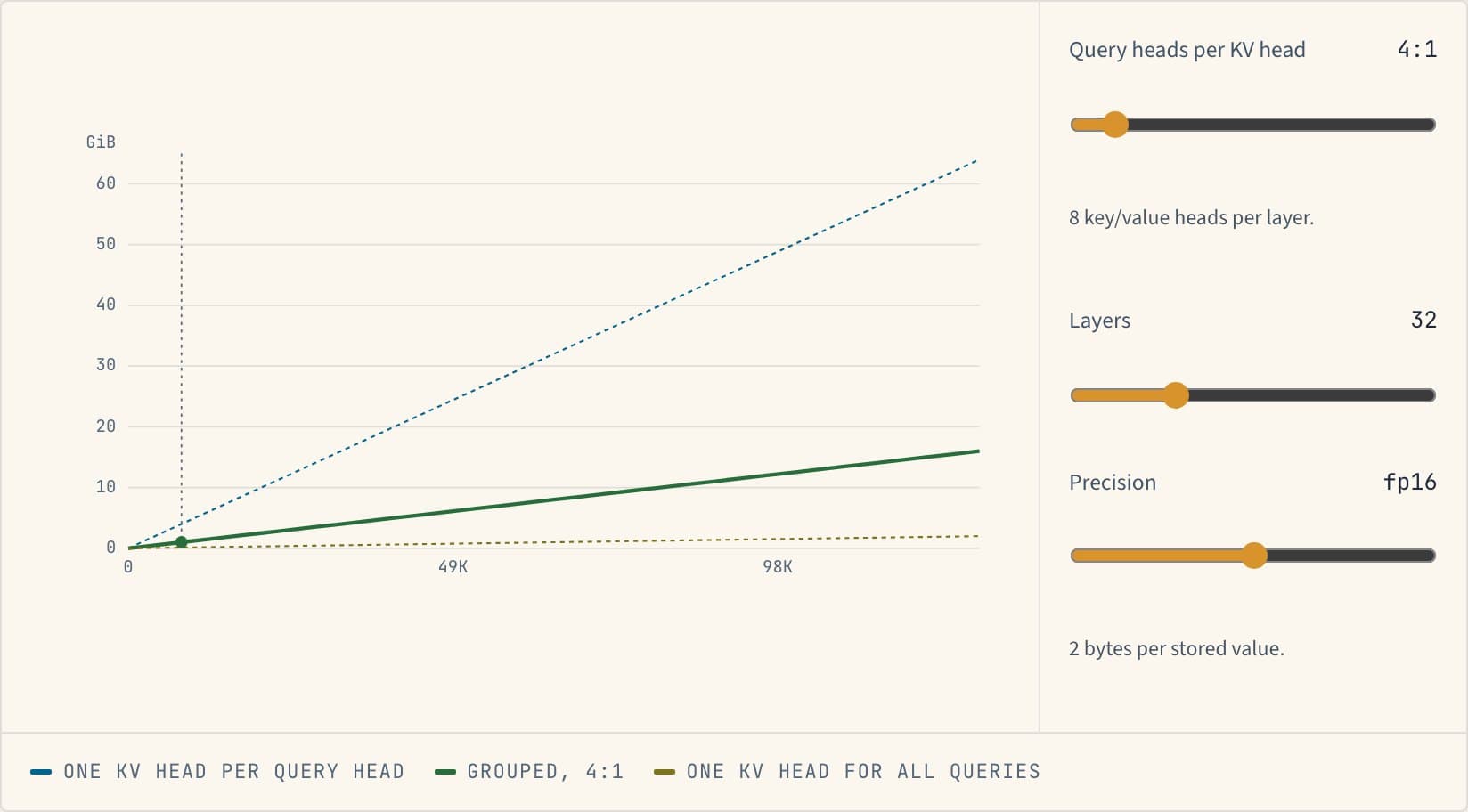
Background and contactTransformer systems: KV memory and serving trade-offs
The Lab follows a transformer from one gradient update to a serving decision: rotary position embeddings, grouped-query attention and the KV cache, long context, batching and decoding, speculative decoding, evaluation design, and a final station where you state and bound a systems claim. Each station asks for a prediction before it shows the calculation.
What to inspect. Change how many query heads share each key/value head and trace which stored quantity changes, then check the formula printed beside the chart.
Attention: one calculation in mathematics, code and controls
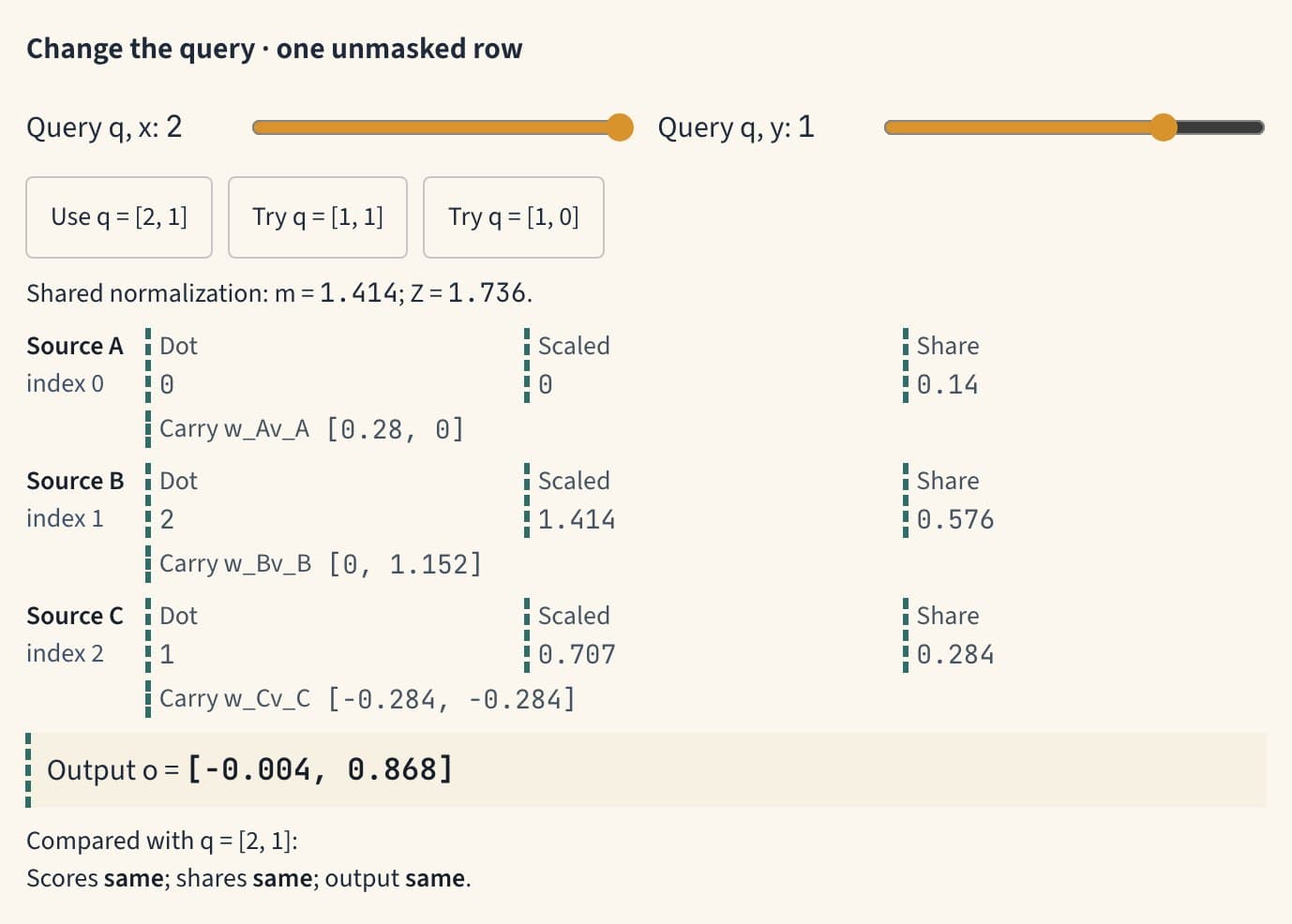
The attention notebook is built around one small example: a query, three sources, and the scores, weights and output they produce. The explanation, the equations, the Python and the interactive figure describe the same calculation, so a statement made in one of them can be checked in the others.
What to inspect. Change the query, then change a value, and notice which quantities move: the scores depend only on the query and the keys, while the output also depends on the values. The notebook can export the current example as a Python notebook, and the site’s tests run that Python and compare it with the in-browser calculation.
Verify: what a paired evaluation supports
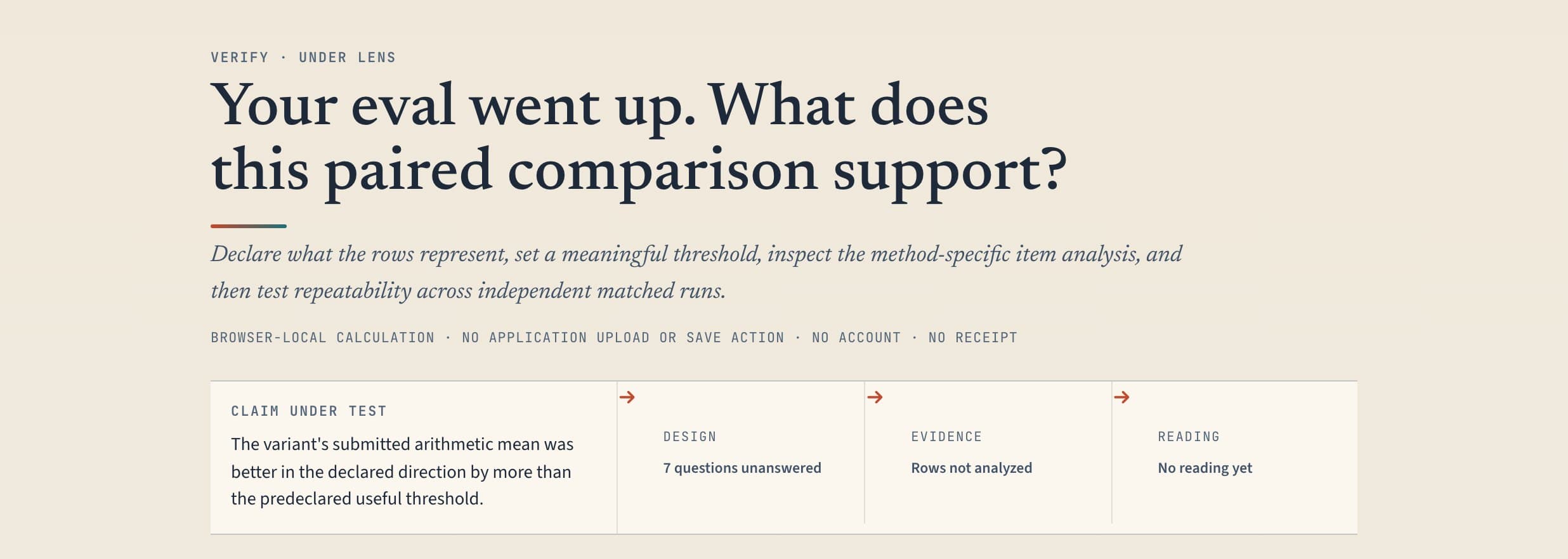
A variant scored higher than a baseline on the same items. Verify examines what that paired comparison supports under the assumptions you declare: which direction counts as better, what the items represent and the smallest difference that would matter.
It applies McNemar’s test with a Newcombe interval to exact 0/1 pairs, and a paired Student-t interval only when the declared assumptions support one. Repeatability is a separate test across at least five independent matched reruns. Based on your declarations, it declines designs outside its supported assumptions, such as clustered, weighted or repeated-generation evaluations, rather than approximating them; it does not verify the declarations.
What to inspect. Describe the rows as a fixed evaluation set and then as an independent sample, and see how the reading changes. Then see what it declines to compute.
How it is built and checked
The site is a statically generated Next.js and TypeScript application with no accounts, advertising or analytics; interactive state stays in your browser. Two checks show how correctness is handled:
- The attention notebook’s Python export is executed by the test suite and compared with the in-browser calculation and with an independently worked example.
- The gradient-descent lesson once misclassified the critical step size, where the iterates neither shrink nor grow. The fix came with a test that checks all 1,288 slider settings against exact rational arithmetic.
On every pull request, continuous integration runs the unit tests, browser tests at desktop and phone widths (including keyboard use), content validation and a production build. Much of the implementation is written with AI coding agents working under my direction; I decide what to build and what ships, and agent-written code has to pass the same checks as any other change. The checks cover the behavior they test, not every possible use.
Research proposal: multi-principal agent networks
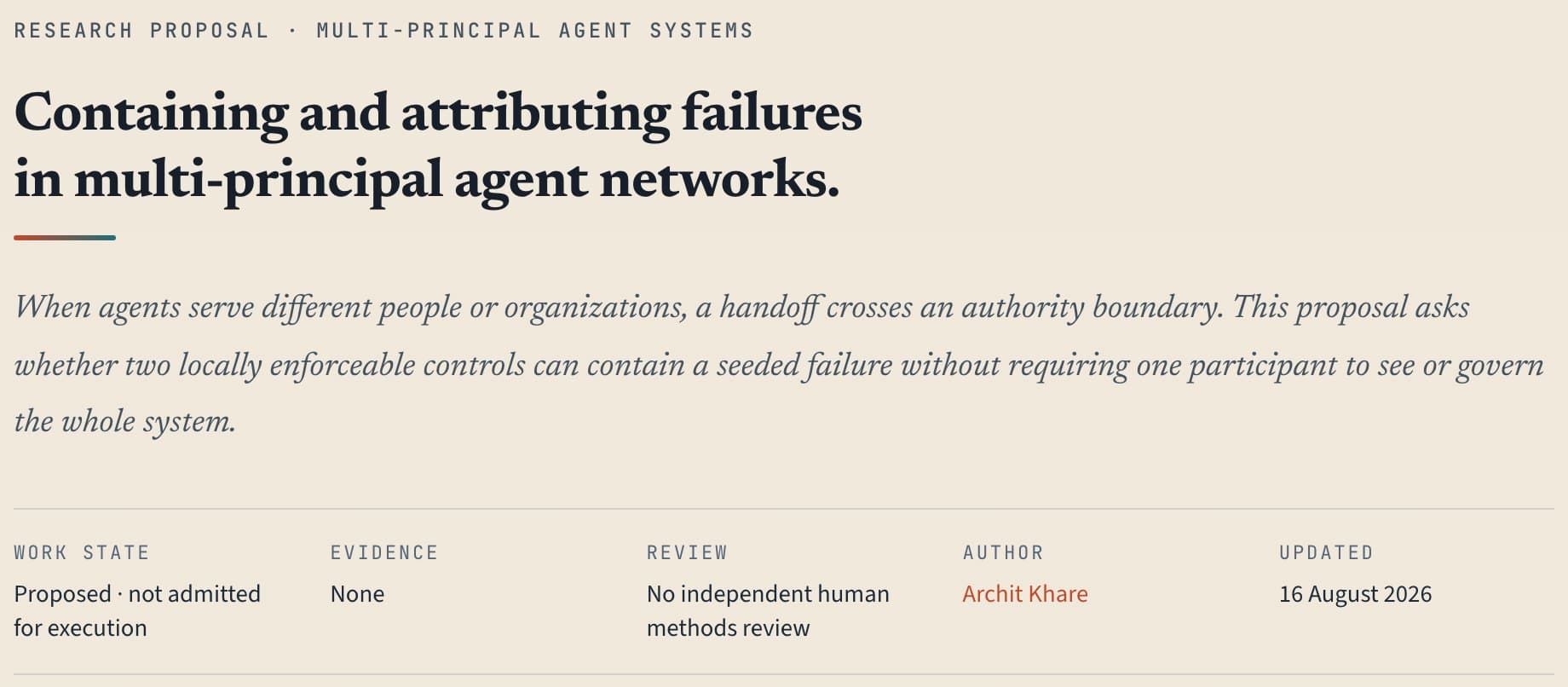
Status. This proposal has not been run. It is presented here as a design example, separate from the current research question on the Research page.
When AI agents act for different people or organizations, a handoff between them crosses an authority boundary. This proposal asks whether two controls that each participant can enforce locally can contain a seeded failure without anyone having to see or govern the whole system, and whether the failure can then be attributed.
What to inspect. The two crossed controls, the separate check that legitimate work still completes, the semantic negative control, and the conditions under which the proposal should not be run at all.
Earlier collaborative work: Cisco Time Series Model
Before Continuous Function I worked at Splunk (acquired by Cisco) as a machine learning engineer. I am one of the authors of the Cisco Time Series Model technical report, in the author group credited with equal contributions to its core development, and of the released model. The model is a zero-shot forecaster: a decoder-only time series model (TimesFM) extended to accept multiresolution input and trained on more than 300 billion data points.
What to inspect. The contribution note in the author list and the section on the multiresolution architecture.
Background and contact
I have worked for more than seven years across deep learning, foundation models, language systems, information retrieval, fine-tuning, recommendation systems and large-scale experimentation. I left Splunk in January 2026, and Continuous Function has been my full-time focus since June 2026.
To discuss a role, a fellowship or a research proposal, email founder@continuousfunction.ai. I am also on LinkedIn and GitHub.
What is not established: the site collects no analytics, so I make no claim about how many people use it; the learning pages have not been evaluated in a study with learners; the research pages are proposals, with no study run and no peer review; and the source repository is private.