When a page feels too hard, use incoming edges to locate the idea that should be repaired first.
Try a bridgeKnowledge Graph
Ask the map what to learn next.
Use the graph as a research-learning instrument: map papers to concepts, inspect typed edges, find prerequisite repairs, and attach equations, labs, claims, and discussion to the exact idea.
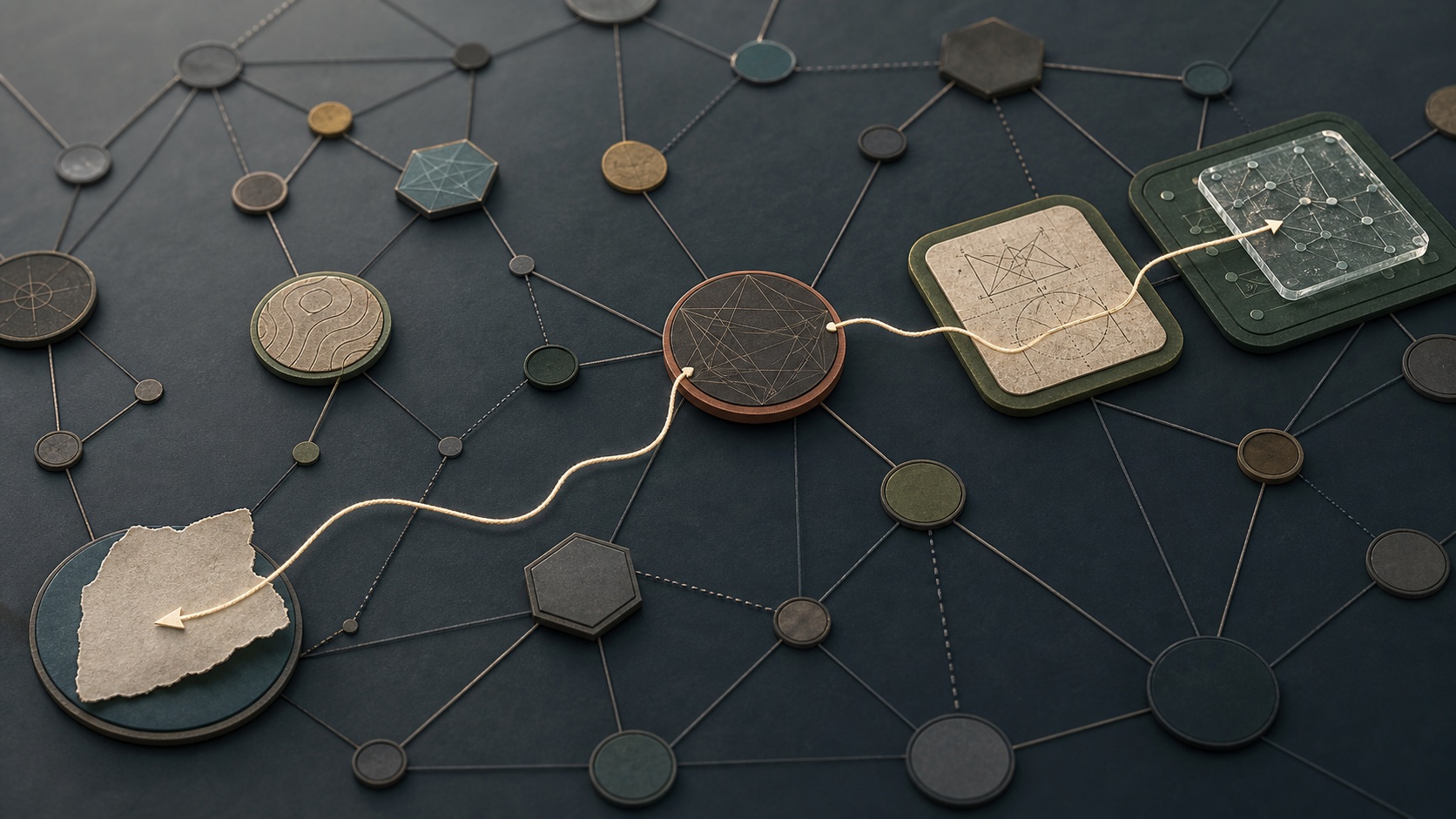
Graph Reading
A graph is useful only when it explains the next move.
The point is not to admire complexity; it is to find the shortest honest path from confusion to a concept you can test.Follow shared neighborhoods to see when optimization, probability, or representation ideas are doing the same job.
Search mechanismsUse the graph to choose the minimum sequence that makes a derivation or demo feel earned.
Open pillarsLearning Route
Ask the graph what to learn next.
Pick a question and the graph turns it into prerequisites, equations, labs, and honest links between ideas. When you arrive from the mapper, your current paper route stays visible.
Answer
I know transformers and Adam. What do I need for Mamba-2?
Repair the long-context pressure first, then cross the bridge from attention memory to fixed-state recurrence.
Search this routePreview only; your saved route is unchanged.
01Attentionknown transformer mechanism02Efficient Attentionwhy KV memory hurts03Long Contextsystems pressure04Linear Transformationsstate update language
05SSM Hybridsrecurrence bridgeplanned
06Parallel Scanimplementation trickplanned
07State-Space Dualitypaper-specific bridgeplanned
Route Engine
Compute the honest next path.
Choose what the learner already knows and a frontier target. The engine runs a weighted shortest-path query over typed concept edges, then names the first missing repair instead of hand-waving across the gap.
Known concepts
Research target
6 nodesRepair Efficient Attention next
weighted cost5.50
Preview only; changing chips does not overwrite your saved route.
01Attentionweighted copying02Efficient Attentionmemory pressure03Long Contextstress regime04SSM Hybridsfixed-state sequence models
05Parallel Scantrainable recurrenceplanned
06State-Space DualityMamba-style bridgeplanned
You need Q/K/V weighted copying before cache and memory optimizations are meaningful.
Long context exposes the cost of storing and repeatedly reading all prior keys and values.
Fixed-state sequence models become attractive when KV memory grows with sequence length.
Recurrent-looking models need parallel sequence computation to train at scale.
Modern Mamba-style papers often connect recurrence, convolution, and attention-like views.
Typed Edges
Why the route is honest
You need weighted copying before memory optimization makes sense.
Long contexts expose the cost of storing and reading all prior keys and values.
Fixed-size states are attractive because KV memory grows with sequence length.
Training recurrent-looking models at scale requires parallelizable sequence computation.
Learning Objects
What anchors this route
mapper candidate
needs explainer
planned
object question
Research Room
Resolve the route object before moving on
Pick a paper, equation, lab, claim, or misconception. The selected object becomes the saved route focus for the next companion prompt.Mamba-2 / state-space duality
Anchored question
What should we inspect about Mamba-2 / state-space duality before treating this route object as understood?
Local action draftDraft unavailableNeeds a canonical object key
Local action draft
This object needs a content object key before local action drafts can attach to it.
No local draft saved.
- Paper metadata, abstract claim, and any pasted source spans
- Mapped concepts, equations, and prerequisite repairs
- Which claims are source-checked and which remain local-preview only
- The paper contribution is mapped to a concrete mechanism
- Unverified author, date, benchmark, and novelty claims are separated from learning claims
- The next concept or lab action is specific enough to resume later
Grounded AI handoff
I am working in Continuous Function's research reading room. Object: paper - Mamba-2 / state-space duality Context: mapper candidate Anchor id: paper/graph/mamba/mamba-state-space-duality Open question: What should we inspect about Mamba-2 / state-space duality before treating this route object as understood? Evidence to inspect: - Paper metadata, abstract claim, and any pasted source spans - Mapped concepts, equations, and prerequisite repairs - Which claims are source-checked and which remain local-preview only What would resolve this: - The paper contribution is mapped to a concrete mechanism - Unverified author, date, benchmark, and novelty claims are separated from learning claims - The next concept or lab action is specific enough to resume later Answer as a careful research tutor: stay source-grounded, separate verified evidence from assumptions, name the relevant math objects, and end with one next action.
paper/graph/mamba/mamba-state-space-duality