Bring the mental model from Scaled Dot-Product Attention & Transformer Layers; this page will reuse it instead of restarting from zero.
MoE Serving & Scheduling: Token Dispatch, All-to-All, Disaggregated Parallelism
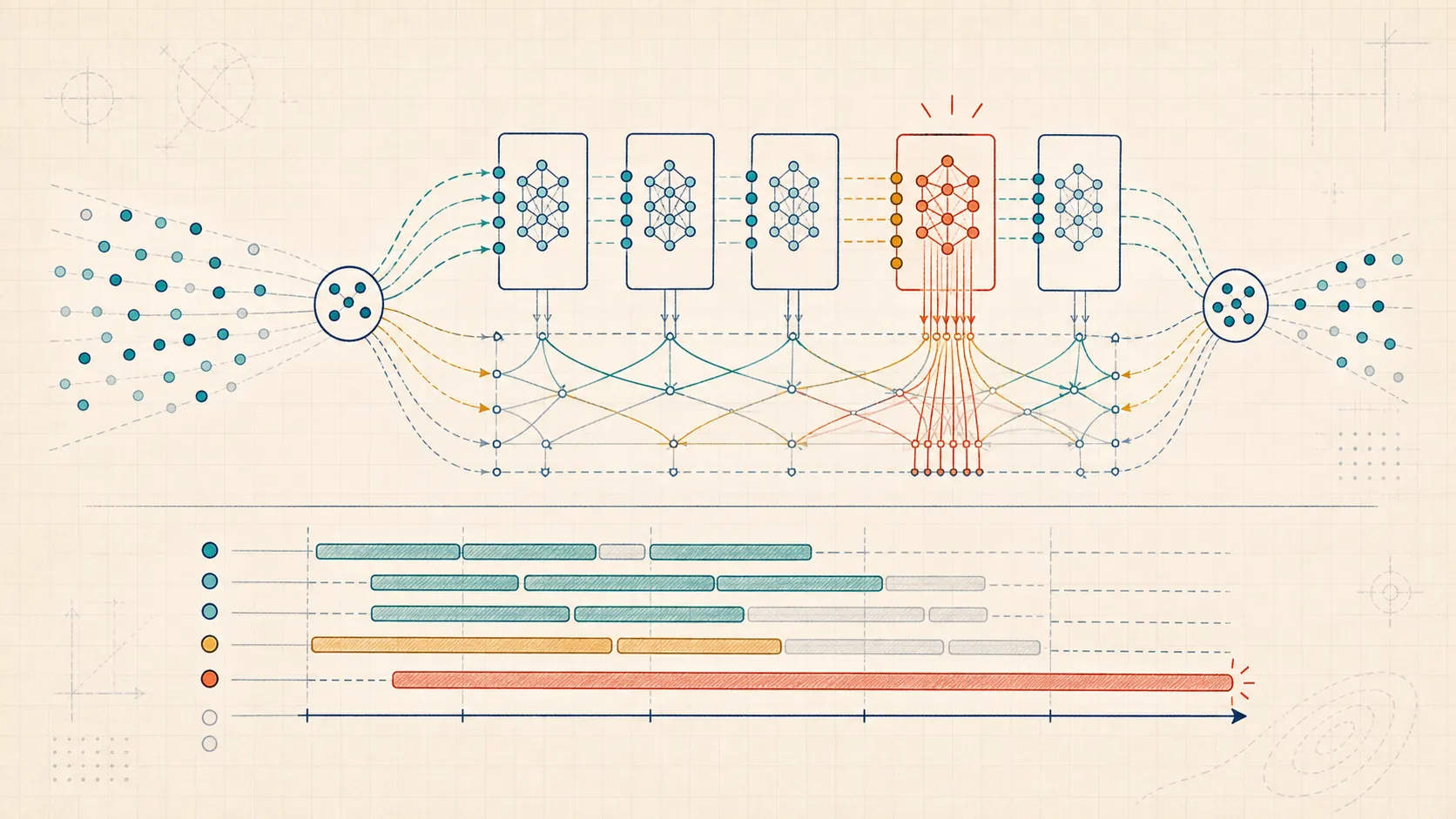
Serving MoE turns sparse compute into a scheduling problem: routing skew can create stragglers and token-dispatch communication can bottleneck, motivating scheduling and, in systems such as MegaScale-Infer, disaggregated expert-parallel serving.
Intuition
Build the mental picture first so the rest of the page has something to attach to.
PredictName the object in plain language, then predict what should change.Leave with one reusable mental picture before notation appears.
MoE looks like "cheaper inference": only run a few experts per token.
In serving, the story flips. MoE becomes a systems scheduling problem:
- tokens get routed unevenly, so some experts become bottlenecks (stragglers),
- expert-parallel MoE layers must dispatch token activations to the selected experts and combine results; this is often all-to-all in colocated expert parallelism and becomes M2N/N2M in disaggregated layouts such as MegaScale-Infer,
- at decode time, you also carry the KV cache burden, so you are juggling both memory and communication.
MegaScale-Infer illustrates the systems goal: keep GPUs busy despite sparsity, skew, and communication overhead. The biggest wins are not guaranteed by sparse FLOPs alone; they come from the surrounding scheduling, batching, and communication plan.
Section prompt
Copy-only prompts — each action copies a page-grounded prompt to your clipboard. Nothing is sent by this site.
Math
Translate the story into symbols, assumptions, and a derivation you can inspect.
InspectTrack the same object through the notation and check each symbol.Leave with the invariant the equations preserve.
Equation 1Inspect equation objectBytes_{comm} \approx 2\cdot T\cdot k\cdot d_{model}\cdot b,Equation 2Inspect equation objectt_{layer} \approx \max_e t_e \propto \max_e n_e.
Token dispatch communication (why layout matters)
Per MoE layer, tokens are routed to experts and then combined back. A crude but useful byte-count is:
where:
- is tokens in the microbatch,
- is top- experts per token,
- is hidden width,
- is bytes per element (e.g., 2 for fp16),
- the factor of 2 is dispatch + combine.
If communication is the bottleneck, adding more experts can make you slower even if compute drops.
Stragglers from routing skew
Let be the number of tokens routed to expert in a microbatch. If expert compute time is proportional to token count, then layer time is dominated by:
Even if the average load is small, the maximum load can be much larger when routing is skewed. Tail latency kills throughput.
Disaggregation (separate pools)
One modern response is disaggregation: run attention in one pool of GPUs and experts in another, pipelining between them. This trades extra communication for higher utilization and better resource matching.
Section prompt
Copy-only prompts — each action copies a page-grounded prompt to your clipboard. Nothing is sent by this site.
Code
Keep the implementation aligned with the notation so the algorithm is legible.
TraceMatch variables to symbols before reading the implementation.Leave with a runnable witness for the math.
import numpy as np

rng = np.random.default_rng(0)
E = 16        # experts
T = 4096      # tokens in a microbatch

# A skewed routing distribution (one "popular" expert)
p = np.ones(E) * 0.9
p[0] = 6.0
p = p / p.sum()

choices = rng.choice(E, size=T, p=p)  # top-1 for simplicity
counts = np.bincount(choices, minlength=E)

print("avg tokens/expert:", round(float(counts.mean()), 2))
print("max tokens/expert:", int(counts.max()))
print("straggler factor max/mean:", round(float(counts.max() / counts.mean()), 2))
print("top-5 expert loads:", np.sort(counts)[-5:][::-1].tolist())
Section prompt
Copy-only prompts — each action copies a page-grounded prompt to your clipboard. Nothing is sent by this site.
Interactive Demo
Use direct manipulation to connect the explanation to a moving system.
ManipulateChange one control and predict the visible response before reveal.Leave with the observed invariant or a repaired model.
Live Concept Demo
Explore MoE Serving & Scheduling: Token Dispatch, All-to-All, Disaggregated Parallelism
The stage is code-native and interactive. Use it to test the explanation against the mechanism.
difficulty 4/5graduatecode-aligned
Demo inquiry checkpoint
Manipulate one control and predict the visible change.
Choose what to inspect in MoE Serving & Scheduling: Token Dispatch, All-to-All, Disaggregated Parallelism. This shared fallback is an observation guide, not evidence of learning.
Loading interactive demo...
The demo below asks you to predict the serving bottleneck before revealing expert loads and token-dispatch communication bytes. The key invariant is that sparse activated compute does not guarantee low latency: routing skew and dispatch/combine traffic can bottleneck the layer.
Section prompt
Copy-only prompts — each action copies a page-grounded prompt to your clipboard. Nothing is sent by this site.
4/4 sections ready
Concept: MoE Serving & Scheduling: Token Dispatch, All-to-All, Disaggregated Parallelism
What is the smallest example that makes MoE Serving & Scheduling: Token Dispatch, All-to-All, Disaggregated Parallelism click without losing the math?
BeforeScaled Dot-Product Attention & Transformer LayersNow4/4 sections readyTryManipulate one control and predict the visible change.NextSpeculative Decoding: Lossless Multi-Token Generation
Object contextLLM Systems
StateLLM Systems
3 sources attachedChecking local snapshot
concept:llm-systems/moe-servingMath2 equation objectsBytes_{comm} \approx 2\cdot T\cdot k\cdot d_{model}\cdot b,CodeMoE Serving & Scheduling: Token Dispatch, All-to-All, Disaggregated P...rng = np.random.default_rng(0)DemoMoE Serving & Scheduling: Token Dispatch, All-to-All, Disaggregated P...Manipulate one control and predict the visible change.
ConceptLearner lens
MoE Serving & Scheduling: Token Dispatch, All-to-All, Disaggregated Parallelism
What is the smallest example that makes MoE Serving & Scheduling: Token Dispatch, All-to-All, Disaggregated Parallelism click without losing the math?
Mode questionCan I say the mechanism back in one sentence before I reveal anything?
Start with the prediction checkpoint, then compare the reveal to the mental model.
Take this moveStudy modes
Keep the object fixed; change the lens.Route back through the notebook
Carry the same object through intuition, math, code, and demo.
Serving MoE turns sparse compute into a scheduling problem: routing skew can create stragglers and token-dispatch communication can bottleneck, motivating scheduling and, in systems such as MegaScale-Infer, disaggregated expert-parallel serving.
The next edge should feel earned: use the demo prediction here before following Speculative Decoding: Lossless Multi-Token Generation.
After The First Pass
Turn the concept into an inspected object.
The lower panels are one second act: keep the object fixed, inspect it visually, check source boundaries, practice transfer, then attach the research question.ConceptMoE Serving & Scheduling: Token Dispatch, All-to-All, Disaggregated ParallelismLLM Systems
01MechanismInspect motionSee how the idea changes form before adding more explanation.02VisualChoose a cueBind one visible mark to one mathematical role.03SourcesCheck boundary3 source links attached to the object.04ClaimAudit evidenceTreat the page claim as something to verify.05PracticeAttempt transferWrite before feedback so the model has something to repair.06RoomAsk groundedAttach the question to the same exact object.
Mechanism Storyboard
See the idea move before the page explains it
Serving MoE turns sparse compute into a scheduling problem: routing skew can create stragglers and token-dispatch communication can bottleneck, motivating scheduling and, in systems such as MegaScale-Infer, disaggregated expert-parallel serving.
Demo notes open01 / Intuition
Prediction lens
Start with the picture, metaphor, or geometric mechanism.
Commit first
Before reading further, choose the kind of change MoE Serving & Scheduling: Token Dispatch, All-to-All, Disaggregated Parallelism should make visible.
Visual Inquiry
Make the image answer a mathematical question
Serving MoE turns sparse compute into a scheduling problem: routing skew can create stragglers and token-dispatch communication can bottleneck, motivating scheduling and, in systems such as MegaScale-Infer, disaggregated expert-parallel serving.
4/4 stages readyDemo notes connected
Visual cueWhich visible object should carry the first intuition?
Prediction
Which visible object should carry the first intuition?
Commit first
Pick the cue that should make MoE Serving & Scheduling: Token Dispatch, All-to-All, Disaggregated Parallelism easier to reason about before the page gives the answer.
Source Grounding
Canonical references for the mechanism on this page.
Object - ConceptMoE Serving & Scheduling: Token Dispatch, All-to-All, Disaggregated ParallelismQuestion
What is the smallest example that makes MoE Serving & Scheduling: Token Dispatch, All-to-All, Disaggregated Parallelism click without losing the math?
concept:llm-systems/moe-servingsources: shazeer-2017-sparsely-gated-moe, fedus-2021-switch-transformer, zhu-2025-megascale-infer
Open the closest source note before trusting the local explanation.
3 selected-object sources shown first; 3 references total.
Audit the claim boundary, then ask from the same selected object.
Located CF editorial boundary
Grounds sparse expert routing and why gating turns capacity into dispatch and load-balance constraints.
Used here as
Shazeer supports sparse top-k MoE routing plus importance/load-balancing losses for uneven expert use. Fedus supports top-1 routing, expert-capacity overflow, auxiliary load balancing, an...
Caveat
Checks sparse routing, uneven expert load, and load-balancing/scheduling only. Shazeer/Fedus ground model/distributed mechanics; MegaScale-Infer supplies serving scope. Local byte-count,...
Located CF editorial boundary
Grounds top-1 routing, capacity factors, and communication/training-stability caveats relevant to serving.
Used here as
Shazeer supports sparse top-k MoE routing plus importance/load-balancing losses for uneven expert use. Fedus supports top-1 routing, expert-capacity overflow, auxiliary load balancing, an...
Caveat
Checks sparse routing, uneven expert load, and load-balancing/scheduling only. Shazeer/Fedus ground model/distributed mechanics; MegaScale-Infer supplies serving scope. Local byte-count,...
Located CF editorial boundary
Serving-specific evidence for MoE decoding sparsity, attention/FFN disaggregation, M2N token-routing communication, and production expert-load imbalance.
Used here as
Shazeer supports sparse top-k MoE routing plus importance/load-balancing losses for uneven expert use. Fedus supports top-1 routing, expert-capacity overflow, auxiliary load balancing, an...
Caveat
Checks sparse routing, uneven expert load, and load-balancing/scheduling only. Shazeer/Fedus ground model/distributed mechanics; MegaScale-Infer supplies serving scope. Local byte-count,...
Claim Review
Serving MoE turns sparse compute into a scheduling problem: routing skew can create stragglers and token-dispatch communication can bottleneck, motivating scheduling and, in systems such as MegaScale-Infer, disaggregated expert-parallel serving.
Object - ConceptMoE Serving & Scheduling: Token Dispatch, All-to-All, Disaggregated ParallelismQuestion
What is the smallest example that makes MoE Serving & Scheduling: Token Dispatch, All-to-All, Disaggregated Parallelism click without losing the math?
concept:llm-systems/moe-servingsources: shazeer-2017-sparsely-gated-moe, fedus-2021-switch-transformer, zhu-2025-megascale-infer
Treat every claim as provisional until source support and a local witness agree.
1 structured claim check on this concept.
Run the prediction or practice transfer before asking for a grounded review.
1 CF editorial source-scope review recorded
Publisher-side editorial review is not independent replication. Claims without it still need exact source-support review. 3 references and 3 local witnesses are available for inspection.
Registered CF editorial boundary
Outrageously Large Neural Networks: The Sparsely-Gated Mixture-of-Experts LayerGrounds sparse expert routing and why gating turns capacity into dispatch and load-balance constraints.Switch Transformers: Scaling to Trillion Parameter Models with Simple and Efficient SparsityGrounds top-1 routing, capacity factors, and communication/training-stability caveats relevant to serving.MegaScale-Infer: Serving Mixture-of-Experts at Scale with Disaggregated Expert ParallelismServing-specific evidence for MoE decoding sparsity, attention/FFN disaggregation, M2N token-routing communication, and production expert-load imba...
Used here as
Shazeer supports sparse top-k MoE routing plus importance/load-balancing losses for uneven expert use. Fedus supports top-1 routing, expert-capacity overflow, auxiliary load balancing, and communication-cost...
Local witnessEquation 2 Code witness 1import numpy as np rng = np.random.default_rng(0) E = 16 # experts T = 4096 # tokens in a mic...
source-span-shazeer-2017-sparsely-gated-moesource-span-fedus-2021-switch-transformersource-span-zhu-2025-megascale-infermath-object-2code-witness-1interactive-demo
Caveat
Checks sparse routing, uneven expert load, and load-balancing/scheduling only. Shazeer/Fedus ground model/distributed mechanics; MegaScale-Infer supplies serving scope. Local byte-count, straggler formula, c...
Review stateCF editorial source-scope reviewClaim metadata: source checkedPublisher-side editorial review only; not independent replication. Check caveats and exact source scope.
Shazeer 2017 supports sparse top-k MoE routing and load/importance-balancing losses for uneven expert use. Fedus 2021 supports top-1 routing, capacity overflow, auxiliary load balancing, and communication-cost tradeoffs. MegaScale-Infer 2025 supplies serving evidence for MoE decoding, token dispatch, FFN underutilization from sparsity, attention/FFN disaggregation, M2N/N2M communication in that setup, and production expert-load imbalance. Local math/code/demo remain toy witnesses.
Reviewer: codex+oracle; reviewed 2026-05-07Practice · MoE Serving & Scheduling: Token Dispatch, All-to-All, Disaggregated Parallelism
Try the idea in your own words
Serving MoE turns sparse compute into a scheduling problem: routing skew can create stragglers and token-dispatch communication can bottleneck, motivating scheduling and, in systems such as MegaScale-Infer, disaggregated expert-parallel serving.
Concept · Current object
MoE Serving & Scheduling: Token Dispatch, All-to-All, Disaggregated Parallelism
Source boundary: sources: shazeer-2017-sparsely-gated-moe, fedus-2021-switch-transformer, zhu-2025-megascale-infer
Object context and links
LLM Systems
concept:llm-systems/moe-servingExplain the mechanism
For MoE Serving & Scheduling: Token Dispatch, All-to-All, Disaggregated Parallelism: What is the smallest example that makes MoE Serving & Scheduling: Token Dispatch, All-to-All, Disaggregated Parallelism click without losing the math? Explain your answer, including what changes, why, and which assumption matters.
No answer yet
A rough first thought is enough. Your draft stays when you change tasks.
Local to this page session. Not saved after leaving or reloading.
A little help · Explain
Open one hint at a time. These are suggestions, not your answer or a grade.
0 of 3 hints shown for this question.
Clearing your answer does not erase help history. Outside help cannot be verified here.
Where am I stuck? (optional)
Take your draft to a feedback conversation
No AI feedback runs here. You can copy a prompt to use elsewhere; nothing is sent automatically. Review the text before sharing, and leave out private information.
Write an attempt before copying a feedback prompt.
This draft and any AI response do not establish mastery. Try a different case later without help; this page has not measured that learning.
Grounded object roomClose
Selected object routeAsk from this object; carry one invariant back.sources: shazeer-2017-sparsely-gated-moe, fedus-2021-switch-transformer, zhu-2025-megascale-infer
- ObjectConceptMoE Serving & Scheduling: Token Dispatch, All-to-All, Disaggregated P...
- PredictBefore revealMoE Serving & Scheduling: Token Dispatch, All-to-All, Disaggregated P...
- WitnessCompare codeMoE Serving & Scheduling: Token Dispatch, All-to-All, Disaggregated P...
- RoomAsk groundedChecking local snapshot
ConceptMoE Serving & Scheduling: Token Dispatch, All-to-All, Disaggregated ParallelismLLM Systems
Code witness comparisonMoE Serving & Scheduling: Token Dispatch, All-to-All, Disaggregated Parallelism code wi...rng = np.random.default_rng(0)Prediction before revealMoE Serving & Scheduling: Token Dispatch, All-to-All, Disaggregated Parallelism predictionManipulate one control and predict the visible change.
Grounded room questionWhat is the smallest example that makes MoE Serving & Scheduling: Token Dispatch, All-to-All, Disaggregated Parallelism click without losing the math?Checking local snapshot
Research Room
Attach the question to an exact object
Pick the concept, equation, source, code witness, claim, misconception, or demo state before asking for help. The handoff stays grounded to that object.Open the draft below to save one note and next action in this browser.
MoE Serving & Scheduling: Token Dispatch, All-to-All, Disaggregated Parallelism
Anchored question
What is the smallest example that makes MoE Serving & Scheduling: Token Dispatch, All-to-All, Disaggregated Parallelism click without losing the math?
Source boundaryInspect source ids: shazeer-2017-sparsely-gated-moe, fedus-2021-switch-transformer, zhu-2025-megascale-inferStable content-object key attached
Role lenses for this object
These are fixed, deterministic perspectives derived from the selected object. They do not represent people, community contributions, or independent review.
Learner evidence requestAsk what would make "MoE Serving & Scheduling: Token Dispatch, All-to-All, Disaggregated Parallelism" feel predictable rather than familiar.
Source ids shazeer-2017-sparsely-gated-moe, fedus-2021-switch-transformer, zhu-2025-megascale-infer must support the exact object, not just the surrounding topic.
Treat this as a mechanism object: connect the definition to one equation, code witness, or demo before broadening the discussion.
Ask the learner to perturb one representation, then check whether the same invariant survives in math, code, and demo.
The learner can state the mechanism in their own words
Local action draftNo local draft saved yetExpand only when ready to capture one local next action
Local action draft
This draft stays locally in this browser for concept:llm-systems/moe-serving.
No local draft saved.
- Source ids to inspect: shazeer-2017-sparsely-gated-moe, fedus-2021-switch-transformer, zhu-2025-megascale-infer
- Definition, prerequisite, and contrast concept links
- The equation or code witness that makes the concept operational
- One demo state that shows the invariant instead of a slogan
- The learner can state the mechanism in their own words
- The learner can name the prerequisite that would repair confusion
- The learner can predict how the mechanism changes under one perturbation
Object-attached AI handoff
I am working in Continuous Function's research reading room. Object: concept - MoE Serving & Scheduling: Token Dispatch, All-to-All, Disaggregated Parallelism Object key: concept:llm-systems/moe-serving Context: LLM Systems Anchor id: concept/concept-notebook/llm-systems/moe-serving Open question: What is the smallest example that makes MoE Serving & Scheduling: Token Dispatch, All-to-All, Disaggregated Parallelism click without losing the math? Evidence to inspect: - Source ids to inspect: shazeer-2017-sparsely-gated-moe, fedus-2021-switch-transformer, zhu-2025-megascale-infer - Definition, prerequisite, and contrast concept links - The equation or code witness that makes the concept operational - One demo state that shows the invariant instead of a slogan Deterministic role lenses for this object: - Boundary: fixed perspectives, not people, community contributions, or independent review - Source-checking summary: Treat this as a mechanism object: connect the definition to one equation, code witness, or demo before broadening the discussion. - Proposed experiment: Ask the learner to perturb one representation, then check whether the same invariant survives in math, code, and demo. - Teach/transfer move: Turn the mechanism into one sentence that predicts a neighboring concept. - Assumptions: - Source ids shazeer-2017-sparsely-gated-moe, fedus-2021-switch-transformer, zhu-2025-megascale-infer must support the exact object, not just the surrounding topic. - The stable content-object key lets local drafts, prompts, and route memory attach without changing the source page. - The concept explanation is local atlas prose until checked against its math, code, and source support. - Prerequisite gaps should become a repair route, not a reason to leave the object vague. - Role-lens requests: - Learner: ask for "Ask what would make "MoE Serving & Scheduling: Token Dispatch, All-to-All, Disaggregated Parallelism" feel predictable rather than familiar." | assumption: Source ids shazeer-2017-sparsely-gated-moe, fedus-2021-switch-transformer, zhu-2025-megascale-infer must support the exact object, not just the surrounding topic. | next action: The learner can state the mechanism in their own words - Researcher: ask for "Source ids to inspect: shazeer-2017-sparsely-gated-moe, fedus-2021-switch-transformer, zhu-2025-megascale-infer" | assumption: The stable content-object key lets local drafts, prompts, and route memory attach without changing the source page. | next action: The learner can name the prerequisite that would repair confusion - Experimenter: ask for "Choose one variable or condition to perturb before asking for an explanation." | assumption: The concept explanation is local atlas prose until checked against its math, code, and source support. | next action: The learner can predict how the mechanism changes under one perturbation - Professor: ask for "Find the smallest transferable rule a learner could reuse without the AI." | assumption: Prerequisite gaps should become a repair route, not a reason to leave the object vague. | next action: Teach or transfer: Turn the mechanism into one sentence that predicts a neighboring concept. What would resolve this: - The learner can state the mechanism in their own words - The learner can name the prerequisite that would repair confusion - The learner can predict how the mechanism changes under one perturbation Answer as a careful research tutor: stay source-grounded, separate verified evidence from assumptions, name the relevant math objects, and end with one next action. Current deterministic role lens for this object: - Role lens: Learner - Evidence request: Ask what would make "MoE Serving & Scheduling: Token Dispatch, All-to-All, Disaggregated Parallelism" feel predictable rather than familiar. - Assumption to keep visible: Source ids shazeer-2017-sparsely-gated-moe, fedus-2021-switch-transformer, zhu-2025-megascale-infer must support the exact object, not just the surrounding topic. - Proposed experiment: Ask the learner to perturb one representation, then check whether the same invariant survives in math, code, and demo. - Next action: The learner can state the mechanism in their own words
concept/concept-notebook/llm-systems/moe-serving
concept:llm-systems/moe-serving