Bring the mental model from Direct Preference Optimization; this page will reuse it instead of restarting from zero.
Kahneman-Tversky Optimization
KTO turns binary desirable/undesirable labels into a reference-relative utility loss: push a labeled output's policy/reference log-ratio above or below a KL-derived baseline, with saturating gradients.
Intuition
Build the mental picture first so the rest of the page has something to attach to.
PredictName the object in plain language, then predict what should change.Leave with one reusable mental picture before notation appears.
Canonical source: Ethayarajh et al., "KTO: Model Alignment as Prospect Theoretic Optimization", ICML 2024.
The prospect-theory borrowing is specific: KTO uses a reference point and a saturating value function. It is not a claim that the Kahneman-Tversky utility curve is the true psychology of how humans judge text.
DPO teaches one powerful measurement: the policy/reference log-ratio .
That number says how much more the current policy likes a completion than the reference policy did. DPO uses it in pairs: the winner should beat the loser by more than the reference already made it beat the loser.
KTO asks a different question:
Can we use the same policy/reference ratio when the data is only thumbs-up or thumbs-down?
The answer is to compare one labeled output against a reference point. For a desirable output, KTO wants the output's policy/reference log-ratio to rise above the policy's average drift from the reference. For an undesirable output, KTO wants that log-ratio to fall below the same baseline.
The mechanism is:
KTO uses a label-dependent saturating utility of the margin , where is the policy/reference log-ratio and is a KL-derived reference point.
The saturation matters. Once a desirable example is already far above the baseline, or an undesirable example is already far below it, the gradient shrinks. KTO focuses updates near the boundary . That can protect against noisy labels, but it can also underfit examples that are hard yet important.
Section prompt
Copy-only prompts — each action copies a page-grounded prompt to your clipboard. Nothing is sent by this site.
Math
Translate the story into symbols, assumptions, and a derivation you can inspect.
InspectTrack the same object through the notation and check each symbol.Leave with the invariant the equations preserve.
Equation 1Inspect equation objectr_\theta(x,y) = \log\frac{\pi_\theta(y\mid x)} {\pi_{ref}(y\mid x)}; z_0 = KL(\pi_\theta(\cdo...Equation 2Inspect equation object(\partial \mathcal L_D)/(\partial r_\theta) = -\lambda_D\beta s(1-s); (\partial \mathcal L_U)...Equation 3Inspect equation objectz_0 = KL(\pi_\theta(\cdot\mid x)\|\pi_{ref}(\cdot\mid x)).
Setup
For a prompt , completion , trainable policy , and reference policy , define the KTO implied reward:
With treated as fixed for the update and , the label-dependent derivative through is
For an autoregressive language model, both log-probabilities are sequence log-probabilities: sums over the completion tokens.
Each training example has a binary label , where means desirable and means undesirable.
The KL reference point
KTO does not compare to one rejected completion. It compares to the policy's average reference-relative reward:
Equivalently, this is the current policy's expected implied reward at prompt :
The important scalar is
A desirable output should have positive . An undesirable output should have negative .
In practical KTO training, is usually estimated from mismatched outputs in the same microbatch, clamped to be nonnegative, and treated as a stop-gradient quantity. It controls loss saturation; it is not itself the thing KTO tries to optimize through.
For a microbatch of size , define as the policy/reference log-ratio of a shifted output under prompt :
A toy version of the paper's reference estimate is then
The point is not to reuse the labeled pair , because those completions were deliberately selected as good or bad and can have unrepresentative rewards.
Label-dependent value and loss
KTO uses a logistic value function. For a desirable example,
For an undesirable example,
The default KTO loss subtracts this value from the label's class weight:
Over the dataset, this is:
So the two label cases are:
and
Gradient descent pushes desirable examples upward in reference-relative reward and undesirable examples downward. If is treated as fixed for the update, let . Then
while
Both gradients have their largest magnitude near , then saturate.
Here is KTO's value-function saturation parameter. It has a practical anchoring effect similar to DPO's , but in KTO it is introduced directly to control how quickly utility saturates.
The weights and are class/utility weights, not a universal moral setting. They are often chosen to account for the ratio of desirable to undesirable examples. Increasing emphasizes undesirable examples; increasing emphasizes desirable examples.
How this differs from DPO
DPO uses a pairwise margin:
KTO uses a pointwise margin:
That is the bridge. DPO asks whether the winner beats the loser by enough. KTO asks whether a single labeled output sits on the correct side of a KL-derived baseline.
Limits of the mechanism
KTO is natural when feedback is already binary or when desirable and undesirable examples are imbalanced. If preference data is clean, consistent, and pairwise, DPO may be the better fit. If labels are noisy or intransitive, KTO's saturation can be useful because extreme examples receive small updates.
When KTO is trained from preference pairs, a common conversion is to treat the preferred response as desirable and the rejected response as undesirable. That is a simplifying assumption, not a law of the method. Naturally binary feedback is the cleaner setting for KTO.
The same property can fail. A hard desirable example with very negative implied reward may be ignored instead of learned. Lower and more epochs can reduce this underfitting risk, but they do not remove it.
A natural next step is Process Reward Models: instead of labeling a whole completion as desirable or undesirable, ask what changes when feedback attaches to intermediate reasoning steps.
Section prompt
Copy-only prompts — each action copies a page-grounded prompt to your clipboard. Nothing is sent by this site.
Code
Keep the implementation aligned with the notation so the algorithm is legible.
TraceMatch variables to symbols before reading the implementation.Leave with a runnable witness for the math.
This small witness mirrors the math: compute the policy/reference log-ratio, estimate a toy KL baseline, apply the label-dependent KTO loss, and inspect the gradient direction.
import numpy as np

def sigmoid(x):
    return 1.0 / (1.0 + np.exp(-x))

# Batch of four labeled prompt/completion examples.
# Shapes:
#   logp_theta, logp_ref, desirable are all (B,)
#   desirable=True means label D; False means label U.
logp_theta = np.array([-8.2, -5.1, -7.0, -6.4])
logp_ref   = np.array([-8.6, -5.0, -6.1, -6.9])
desirable  = np.array([ True, True, False, False])

beta = 0.2
lambda_D = 1.0
lambda_U = 1.0

# KTO implied reward: policy/reference sequence log-ratio.
r = logp_theta - logp_ref

# Toy microbatch estimate of the KL reference point.
# These are log-probabilities for mismatched pairs (x_i, y_j),
# not the original labeled pairs (x_i, y_i).
mismatch_logp_theta = np.array([-6.0, -7.2, -5.8, -8.0])
mismatch_logp_ref   = np.array([-6.3, -7.6, -6.0, -8.2])
mismatch_r = mismatch_logp_theta - mismatch_logp_ref
z0_hat = max(0.0, float(np.mean(mismatch_r)))

delta = r - z0_hat

value_D = lambda_D * sigmoid(beta * delta)
value_U = lambda_U * sigmoid(-beta * delta)

value = np.where(desirable, value_D, value_U)
lambda_y = np.where(desirable, lambda_D, lambda_U)
loss = lambda_y - value

# Stop-gradient z0: derivative is only through r.
s = sigmoid(beta * delta)
grad_D = -lambda_D * beta * s * (1.0 - s)
grad_U =  lambda_U * beta * s * (1.0 - s)
grad_r = np.where(desirable, grad_D, grad_U)

print("r_theta:", np.round(r, 3))
print("mismatched r for z0:", np.round(mismatch_r, 3))
print("z0_hat:", round(z0_hat, 3))
print("delta = r - z0:", np.round(delta, 3))
print("per-example KTO loss:", np.round(loss, 3))
print("d loss / d r:", np.round(grad_r, 3))
print("mean loss:", round(float(loss.mean()), 3))

assert np.all(grad_r[desirable] < 0)
assert np.all(grad_r[~desirable] > 0)
For desirable examples, the gradient is negative, so gradient descent increases . For undesirable examples, the gradient is positive, so gradient descent decreases . In both cases, the magnitude is largest near .
Section prompt
Copy-only prompts — each action copies a page-grounded prompt to your clipboard. Nothing is sent by this site.
Interactive Demo
Use direct manipulation to connect the explanation to a moving system.
ManipulateChange one control and predict the visible response before reveal.Leave with the observed invariant or a repaired model.
Live Concept Demo
Explore Kahneman-Tversky Optimization
The stage is code-native and interactive. Use it to test the explanation against the mechanism.
difficulty 4/5undergraduatecode-aligned
Demo inquiry checkpoint
Manipulate one control and predict the visible change.
Choose what to inspect in Kahneman-Tversky Optimization. This shared fallback is an observation guide, not evidence of learning.
Loading interactive demo...
Use the demo to inspect one labeled example. Change the label, the implied reward , the KL baseline , , and the class weights. Watch the KTO loss and gradient flip direction between desirable and undesirable examples, while saturating away from the baseline.
Section prompt
Copy-only prompts — each action copies a page-grounded prompt to your clipboard. Nothing is sent by this site.
4/4 sections ready
Concept: Kahneman-Tversky Optimization
What is the smallest example that makes Kahneman-Tversky Optimization click without losing the math?
BeforeDirect Preference OptimizationNow4/4 sections readyTryManipulate one control and predict the visible change.NextProcess Reward Models: Step-Level Verifiers for Reasoning
Object contextAlignment
StateAlignment
1 source attachedChecking local snapshot
concept:alignment/ktoMath3 equation objectsr_\theta(x,y) = \log\frac{\pi_\theta(y\mid x)} {\pi_{ref}(y\mid x)}; z_0 = KL(\pi_\theta(\cdo...CodeKahneman-Tversky Optimization code witness 1assert np.all(grad_r[desirable] < 0)DemoKahneman-Tversky Optimization predictionManipulate one control and predict the visible change.
ConceptLearner lens
Kahneman-Tversky Optimization
What is the smallest example that makes Kahneman-Tversky Optimization click without losing the math?
Mode questionCan I say the mechanism back in one sentence before I reveal anything?
Start with the prediction checkpoint, then compare the reveal to the mental model.
Take this moveStudy modes
Keep the object fixed; change the lens.Route back through the notebook
Carry the same object through intuition, math, code, and demo.
KTO turns binary desirable/undesirable labels into a reference-relative utility loss: push a labeled output's policy/reference log-ratio above or below a KL-derived baseline, with saturating gradients.
The next edge should feel earned: use the demo prediction here before following Process Reward Models: Step-Level Verifiers for Reasoning.
After The First Pass
Turn the concept into an inspected object.
The lower panels are one second act: keep the object fixed, inspect it visually, check source boundaries, practice transfer, then attach the research question.ConceptKahneman-Tversky OptimizationAlignment
01MechanismInspect motionSee how the idea changes form before adding more explanation.02VisualChoose a cueBind one visible mark to one mathematical role.03SourcesCheck boundary1 source link attached to the object.04ClaimAudit evidenceTreat the page claim as something to verify.05PracticeAttempt transferWrite before feedback so the model has something to repair.06RoomAsk groundedAttach the question to the same exact object.
Mechanism Storyboard
See the idea move before the page explains it
KTO turns binary desirable/undesirable labels into a reference-relative utility loss: push a labeled output's policy/reference log-ratio above or below a KL-derived baseline, with saturating gradients.
Demo notes open01 / Intuition
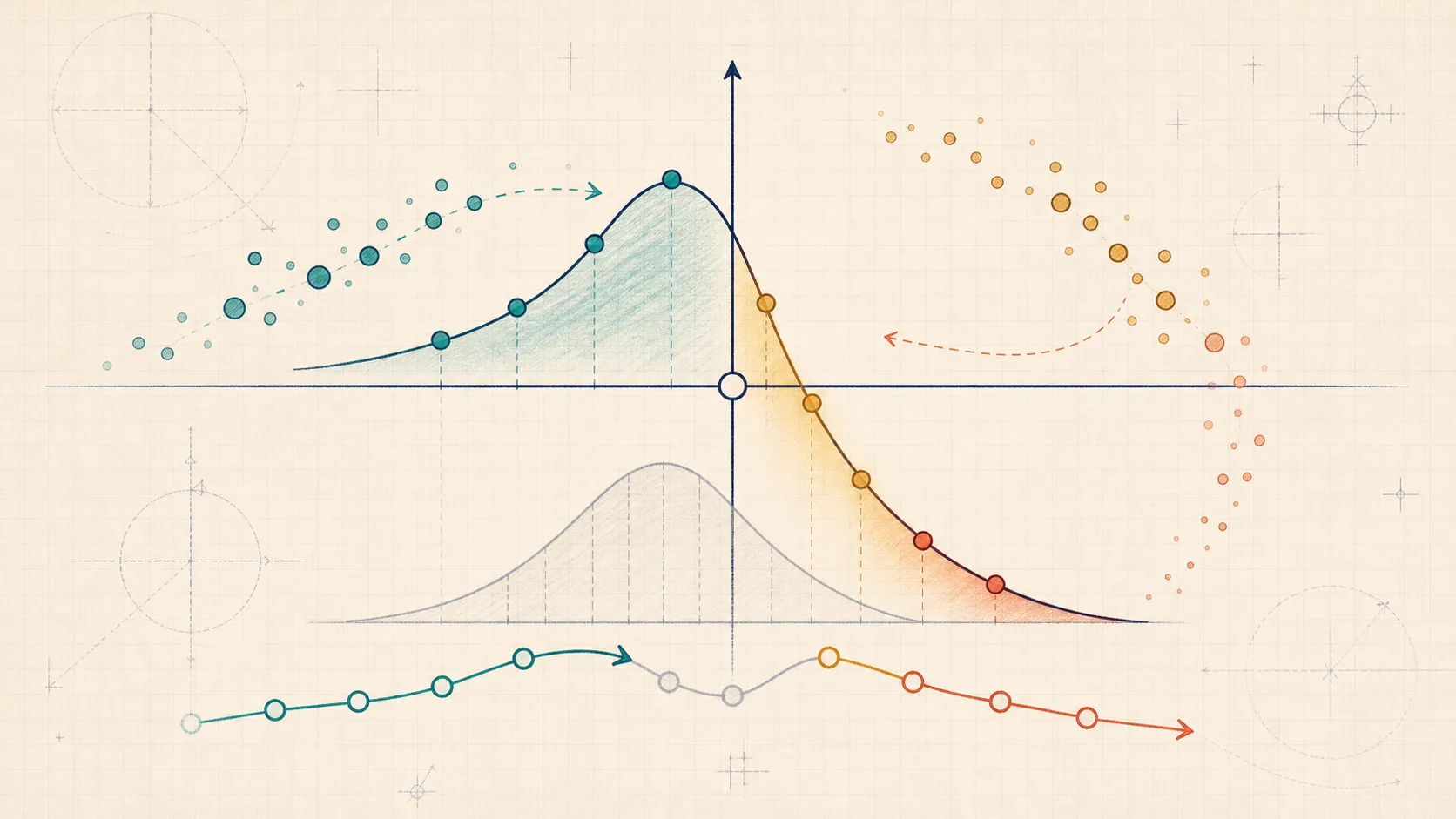
Prediction lens
Start with the picture, metaphor, or geometric mechanism.
Commit first
Before reading further, choose the kind of change Kahneman-Tversky Optimization should make visible.
Visual Inquiry
Make the image answer a mathematical question
KTO turns binary desirable/undesirable labels into a reference-relative utility loss: push a labeled output's policy/reference log-ratio above or below a KL-derived baseline, with saturating gradients.
4/4 stages readyDemo notes connected
Visual cueWhich visible object should carry the first intuition?
Prediction
Which visible object should carry the first intuition?
Commit first
Pick the cue that should make Kahneman-Tversky Optimization easier to reason about before the page gives the answer.
Source Grounding
Canonical references for the mechanism on this page.
Object - ConceptKahneman-Tversky OptimizationQuestion
What is the smallest example that makes Kahneman-Tversky Optimization click without losing the math?
concept:alignment/ktosources: ethayarajh-2024-kto
Open the closest source note before trusting the local explanation.
1 selected-object source shown first; 1 reference total.
Audit the claim boundary, then ask from the same selected object.
Located CF editorial boundary
Grounds KTO as a HALO objective that learns from binary desirable/undesirable feedback instead of pairwise preferences.
Used here as
Ethayarajh et al. define KTO with binary desirable/undesirable labels, r_theta=log(pi_theta/pi_ref), z0 as a KL reference, and v_D/v_U logistic values containing beta. The page's first tw...
Caveat
Covers only the KTO objective/update mechanics. It does not review claims that KTO outperforms DPO, prospect theory is psychologically true for text, every library implements z0 this way,...
Claim Review
KTO turns binary desirable/undesirable labels into a reference-relative utility loss: push a labeled output's policy/reference log-ratio above or below a KL-derived baseline, with saturating gradients.
Object - ConceptKahneman-Tversky OptimizationQuestion
What is the smallest example that makes Kahneman-Tversky Optimization click without losing the math?
concept:alignment/ktosources: ethayarajh-2024-kto
Treat every claim as provisional until source support and a local witness agree.
1 structured claim check on this concept.
Run the prediction or practice transfer before asking for a grounded review.
1 CF editorial source-scope review recorded
Publisher-side editorial review is not independent replication. Claims without it still need exact source-support review. 1 reference and 3 local witnesses are available for inspection.
Registered CF editorial boundary
Used here as
Ethayarajh et al. define KTO with binary desirable/undesirable labels, r_theta=log(pi_theta/pi_ref), z0 as a KL reference, and v_D/v_U logistic values containing beta. The page's first two exported math refs...
Local witnessEquation 1 Equation 2
Caveat
Covers only the KTO objective/update mechanics. It does not review claims that KTO outperforms DPO, prospect theory is psychologically true for text, every library implements z0 this way, or that KTO prevent...
Review stateCF editorial source-scope reviewClaim metadata: source checkedPublisher-side editorial review only; not independent replication. Check caveats and exact source scope.
Ethayarajh et al. support KTO as binary desirable/undesirable optimization with r_theta=log(pi_theta/pi_ref), KL reference z0, logistic label values, and beta saturation. The first two exported equations now witness the objective and stop-gradient derivative signs; code/demo mirror the update directions.
Reviewer: codex+oracle; reviewed 2026-05-07Practice · Kahneman-Tversky Optimization
Try the idea in your own words
KTO turns binary desirable/undesirable labels into a reference-relative utility loss: push a labeled output's policy/reference log-ratio above or below a KL-derived baseline, with saturating gradients.
Concept · Current object
Kahneman-Tversky Optimization
Source boundary: sources: ethayarajh-2024-kto
Object context and links
Alignment
concept:alignment/ktoExplain the mechanism
For Kahneman-Tversky Optimization: What is the smallest example that makes Kahneman-Tversky Optimization click without losing the math? Explain your answer, including what changes, why, and which assumption matters.
No answer yet
A rough first thought is enough. Your draft stays when you change tasks.
Local to this page session. Not saved after leaving or reloading.
A little help · Explain
Open one hint at a time. These are suggestions, not your answer or a grade.
0 of 3 hints shown for this question.
Clearing your answer does not erase help history. Outside help cannot be verified here.
Where am I stuck? (optional)
Take your draft to a feedback conversation
No AI feedback runs here. You can copy a prompt to use elsewhere; nothing is sent automatically. Review the text before sharing, and leave out private information.
Write an attempt before copying a feedback prompt.
This draft and any AI response do not establish mastery. Try a different case later without help; this page has not measured that learning.
Grounded object roomClose
Selected object routeAsk from this object; carry one invariant back.sources: ethayarajh-2024-kto
- ObjectConceptKahneman-Tversky Optimization
- PredictBefore revealKahneman-Tversky Optimization prediction
- WitnessCompare codeKahneman-Tversky Optimization code witness 1
- RoomAsk groundedChecking local snapshot
ConceptKahneman-Tversky OptimizationAlignment
Code witness comparisonKahneman-Tversky Optimization code witness 1assert np.all(grad_r[desirable] < 0)Prediction before revealKahneman-Tversky Optimization predictionManipulate one control and predict the visible change.
Grounded room questionWhat is the smallest example that makes Kahneman-Tversky Optimization click without losing the math?Checking local snapshot
Research Room
Attach the question to an exact object
Pick the concept, equation, source, code witness, claim, misconception, or demo state before asking for help. The handoff stays grounded to that object.Open the draft below to save one note and next action in this browser.
Kahneman-Tversky Optimization
Anchored question
What is the smallest example that makes Kahneman-Tversky Optimization click without losing the math?
Source boundaryInspect source ids: ethayarajh-2024-ktoStable content-object key attached
Role lenses for this object
These are fixed, deterministic perspectives derived from the selected object. They do not represent people, community contributions, or independent review.
Learner evidence requestAsk what would make "Kahneman-Tversky Optimization" feel predictable rather than familiar.
Source ids ethayarajh-2024-kto must support the exact object, not just the surrounding topic.
Treat this as a mechanism object: connect the definition to one equation, code witness, or demo before broadening the discussion.
Ask the learner to perturb one representation, then check whether the same invariant survives in math, code, and demo.
The learner can state the mechanism in their own words
Local action draftNo local draft saved yetExpand only when ready to capture one local next action
Local action draft
This draft stays locally in this browser for concept:alignment/kto.
No local draft saved.
- Source ids to inspect: ethayarajh-2024-kto
- Definition, prerequisite, and contrast concept links
- The equation or code witness that makes the concept operational
- One demo state that shows the invariant instead of a slogan
- The learner can state the mechanism in their own words
- The learner can name the prerequisite that would repair confusion
- The learner can predict how the mechanism changes under one perturbation
Object-attached AI handoff
I am working in Continuous Function's research reading room. Object: concept - Kahneman-Tversky Optimization Object key: concept:alignment/kto Context: Alignment Anchor id: concept/concept-notebook/alignment/kto Open question: What is the smallest example that makes Kahneman-Tversky Optimization click without losing the math? Evidence to inspect: - Source ids to inspect: ethayarajh-2024-kto - Definition, prerequisite, and contrast concept links - The equation or code witness that makes the concept operational - One demo state that shows the invariant instead of a slogan Deterministic role lenses for this object: - Boundary: fixed perspectives, not people, community contributions, or independent review - Source-checking summary: Treat this as a mechanism object: connect the definition to one equation, code witness, or demo before broadening the discussion. - Proposed experiment: Ask the learner to perturb one representation, then check whether the same invariant survives in math, code, and demo. - Teach/transfer move: Turn the mechanism into one sentence that predicts a neighboring concept. - Assumptions: - Source ids ethayarajh-2024-kto must support the exact object, not just the surrounding topic. - The stable content-object key lets local drafts, prompts, and route memory attach without changing the source page. - The concept explanation is local atlas prose until checked against its math, code, and source support. - Prerequisite gaps should become a repair route, not a reason to leave the object vague. - Role-lens requests: - Learner: ask for "Ask what would make "Kahneman-Tversky Optimization" feel predictable rather than familiar." | assumption: Source ids ethayarajh-2024-kto must support the exact object, not just the surrounding topic. | next action: The learner can state the mechanism in their own words - Researcher: ask for "Source ids to inspect: ethayarajh-2024-kto" | assumption: The stable content-object key lets local drafts, prompts, and route memory attach without changing the source page. | next action: The learner can name the prerequisite that would repair confusion - Experimenter: ask for "Choose one variable or condition to perturb before asking for an explanation." | assumption: The concept explanation is local atlas prose until checked against its math, code, and source support. | next action: The learner can predict how the mechanism changes under one perturbation - Professor: ask for "Find the smallest transferable rule a learner could reuse without the AI." | assumption: Prerequisite gaps should become a repair route, not a reason to leave the object vague. | next action: Teach or transfer: Turn the mechanism into one sentence that predicts a neighboring concept. What would resolve this: - The learner can state the mechanism in their own words - The learner can name the prerequisite that would repair confusion - The learner can predict how the mechanism changes under one perturbation Answer as a careful research tutor: stay source-grounded, separate verified evidence from assumptions, name the relevant math objects, and end with one next action. Current deterministic role lens for this object: - Role lens: Learner - Evidence request: Ask what would make "Kahneman-Tversky Optimization" feel predictable rather than familiar. - Assumption to keep visible: Source ids ethayarajh-2024-kto must support the exact object, not just the surrounding topic. - Proposed experiment: Ask the learner to perturb one representation, then check whether the same invariant survives in math, code, and demo. - Next action: The learner can state the mechanism in their own words
concept/concept-notebook/alignment/kto
concept:alignment/kto