Bring the mental model from Test-Time Compute: Spending Inference Budget on Search; this page will reuse it instead of restarting from zero.
Tree Search Reasoning: Allocating Inference Budget Across Prefixes
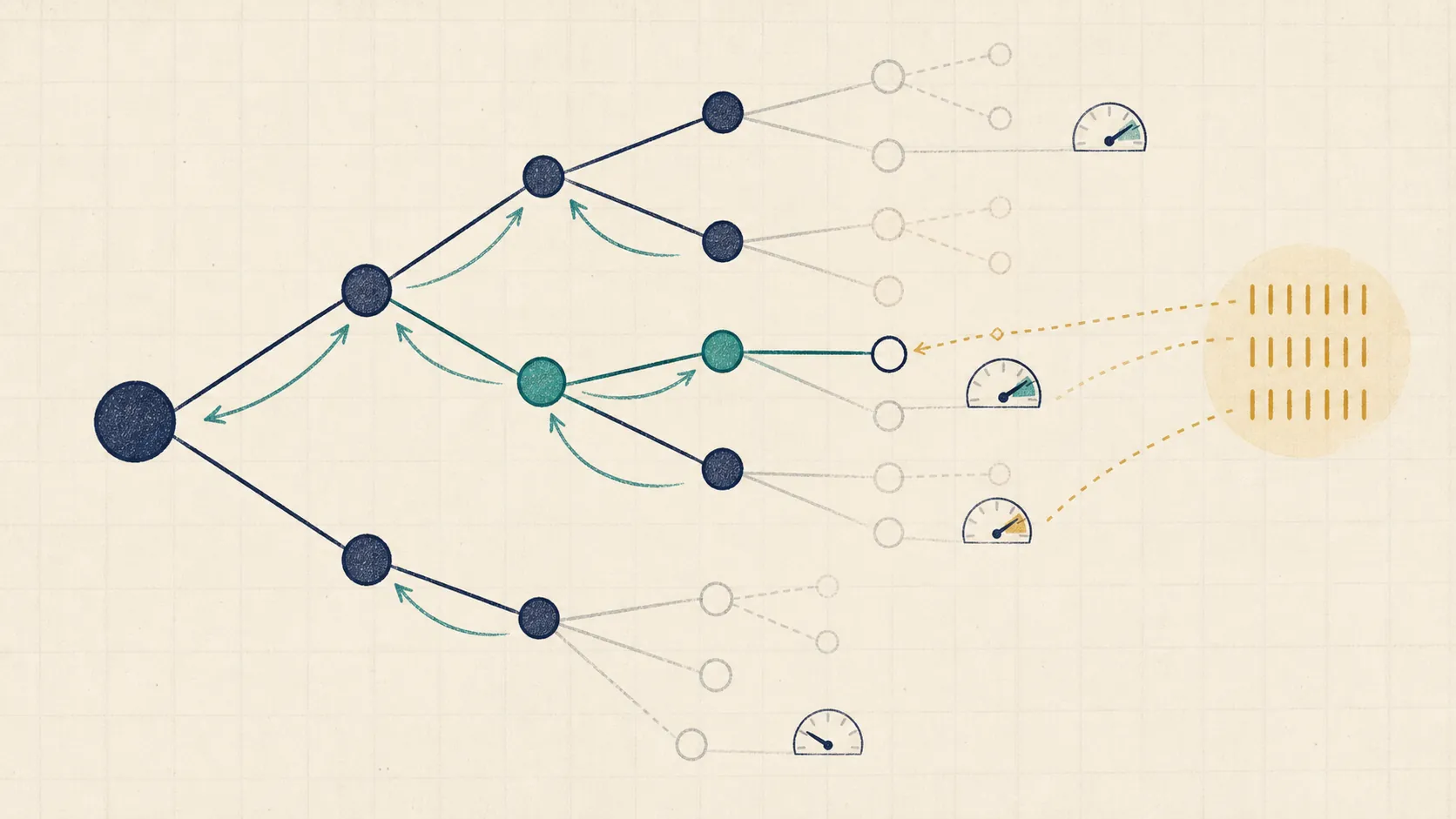
Tree search spends inference budget on partial reasoning prefixes, using local verifier scores, frontier expansion, and max backups to decide which branches deserve more thought.
Intuition
Build the mental picture first so the rest of the page has something to attach to.
PredictName the object in plain language, then predict what should change.Leave with one reusable mental picture before notation appears.
Background references include Cobbe et al., "Training Verifiers to Solve Math Word Problems", Lightman et al., "Let's Verify Step by Step", Brown et al., "Large Language Monkeys", Wang et al., "Self-Consistency Improves Chain of Thought Reasoning", Yao et al., "Tree of Thoughts", and the UCT background note by Kocsis and Szepesvari, "Bandit Based Monte-Carlo Planning". The source-checked core for this page uses Yao et al. for partial-state tree search and Lightman et al. for process-supervised step scoring.
Best-of- search spends all extra compute on complete traces. It samples whole solutions, scores them, and returns the best sampled solution.
Tree search asks a sharper question: after seeing a partial reasoning prefix, which branch deserves more budget?
That changes the unit of allocation. The search state is a prefix : a partial derivation, proof, plan, or scratchpad. A generator proposes next steps. A process reward model or local verifier scores those steps. In the finite teaching model below, a max-backup rule lets a good visible continuation raise the value of the earlier prefix that led to it.
This page teaches a finite prefix-tree mechanism inspired by ToT and PRM-style scoring: visible prefixes, local verifier scores, frontier expansion, max backup, and a toy noisy-verifier failure. Full MCTS, UCT, rollouts, visit counts, PUCT, and AlphaZero-style search are part of the larger family, but they are not the teaching core here.
Section prompt
Copy-only prompts — each action copies a page-grounded prompt to your clipboard. Nothing is sent by this site.
Math
Translate the story into symbols, assumptions, and a derivation you can inspect.
InspectTrack the same object through the notation and check each symbol.Leave with the invariant the equations preserve.
Equation 1Inspect equation objecth=(a_1,\dots,a_t), \qquad ha=(a_1,\dots,a_t,a), \qquad \pi_\theta(a\mid h), \qquad r_\phi(h,a).Equation 2Inspect equation object\mathcal F_t = Frontier(\mathcal T_t); G_\phi(h) = \sum_{(g,a)\in path(h)} r_\phi(g,a); h_t =...Equation 3Inspect equation objectu(z)\in\{0,1\},
Fix one prompt and a finite rooted tree of possible reasoning prefixes. The root is the empty prefix . A node is a prefix , taking next step creates child prefix , the generator proposes that edge, and the local verifier scores it:
Here is the process-reward-model style judgment of whether step is valid after prefix .
At search step , let be the visible subtree. The frontier, cumulative local verifier score, deterministic expansion rule, and page-level max backup are:
A terminal trace also has hidden correctness
but is used only for evaluation, not for search.
Here is a prefix heuristic: how promising an unfinished prefix looks before its children are revealed. The line is the simplest deterministic expansion rule: choose the visible unfinished prefix with the highest current path score plus heuristic.
Expanding reveals its children and scores their incoming edges. This is the unit of inference budget.
The backed-up residual value on the visible tree is the recurrence above: terminal nodes contribute no future score, unfinished frontier nodes use their heuristic, and expanded nodes inherit the best visible child continuation.
The recommended visible path follows the best backed-up child:
This is not a convergence theorem or a claim about perfect planning. It means only: among the continuations currently visible under this prefix, choose the one with the highest verifier-backed score.
A compact cost model is
where is the set of generated children revealed when prefix is expanded.
The contrast with best-of- is the frontier. Complete-trace search samples and selects
There is no visible prefix frontier and no bottom-up backup. Tree search replaces "sample another whole trace" with "expand another prefix."
Section prompt
Copy-only prompts — each action copies a page-grounded prompt to your clipboard. Nothing is sent by this site.
Code
Keep the implementation aligned with the notation so the algorithm is legible.
TraceMatch variables to symbols before reading the implementation.Leave with a runnable witness for the math.
This witness runs the same finite prefix tree as the demo for . In clean mode, the best-first frontier reaches a correct terminal trace. In noisy mode, an invalid shortcut is falsely scored high, and the max backup sends the root toward the wrong terminal.
NODES = {
    "root": {"children": ["A", "B", "C"]},
    "A": {"parent": "root", "children": ["A1"], "clean": -1.2, "noisy": 1.2, "b_clean": -0.3, "b_noisy": 1.1},
    "A1": {"parent": "A", "terminal": True, "correct": False, "clean": -0.4, "noisy": 1.6},
    "B": {"parent": "root", "children": ["B1", "B2"], "clean": 0.8, "noisy": 0.8, "b_clean": 0.9, "b_noisy": 0.9},
    "B1": {"parent": "B", "terminal": True, "correct": True, "clean": 1.0, "noisy": 1.0},
    "B2": {"parent": "B", "terminal": True, "correct": False, "clean": -0.6, "noisy": -0.6},
    "C": {"parent": "root", "children": ["C1", "C2"], "clean": 0.7, "noisy": 0.7, "b_clean": 1.3, "b_noisy": 1.3},
    "C1": {"parent": "C", "children": ["C1a", "C1b"], "clean": 0.9, "noisy": 0.9, "b_clean": 0.8, "b_noisy": 0.8},
    "C1a": {"parent": "C1", "terminal": True, "correct": True, "clean": 0.8, "noisy": 0.8},
    "C1b": {"parent": "C1", "terminal": True, "correct": False, "clean": -0.6, "noisy": -0.6},
    "C2": {"parent": "C", "terminal": True, "correct": False, "clean": -0.8, "noisy": -0.8},
}

ORDER = ["root", "A", "A1", "B", "B1", "B2", "C", "C1", "C1a", "C1b", "C2"]

def score(node_id, mode):
    return NODES[node_id][mode]

def heuristic(node_id, mode):
    return NODES[node_id].get(f"b_{mode}", 0.0)

def cumulative(node_id, mode):
    if node_id == "root":
        return 0.0
    parent = NODES[node_id]["parent"]
    return cumulative(parent, mode) + score(node_id, mode)

def run(mode="clean", budget=2):
    visible = set(["root", *NODES["root"]["children"]])
    expanded = {"root"}

    def is_frontier(node_id):
        node = NODES[node_id]
        return node_id in visible and not node.get("terminal") and node_id not in expanded

    for _ in range(budget):
        frontier = [node_id for node_id in ORDER if is_frontier(node_id)]
        if not frontier:
            break
        chosen = max(frontier, key=lambda node_id: (cumulative(node_id, mode) + heuristic(node_id, mode), node_id))
        expanded.add(chosen)
        visible.update(NODES[chosen].get("children", []))

    def value(node_id):
        node = NODES[node_id]
        if node.get("terminal"):
            return 0.0
        if node_id not in expanded:
            return heuristic(node_id, mode)
        return max(score(child, mode) + value(child) for child in node["children"] if child in visible)

    path = ["root"]
    while path[-1] in expanded and not NODES[path[-1]].get("terminal"):
        children = [child for child in NODES[path[-1]]["children"] if child in visible]
        if not children:
            break
        path.append(max(children, key=lambda child: (score(child, mode) + value(child), child)))

    terminal = path[-1] if NODES[path[-1]].get("terminal") else None
    return {"path": path, "root_value": value("root"), "terminal": terminal}

clean = run("clean", budget=2)
noisy = run("noisy", budget=2)

assert clean["path"] == ["root", "C", "C1", "C1a"]
assert NODES[clean["terminal"]]["correct"] is True
assert noisy["path"] == ["root", "A", "A1"]
assert NODES[noisy["terminal"]]["correct"] is False
print(clean)
print(noisy)
Section prompt
Copy-only prompts — each action copies a page-grounded prompt to your clipboard. Nothing is sent by this site.
Interactive Demo
Use direct manipulation to connect the explanation to a moving system.
ManipulateChange one control and predict the visible response before reveal.Leave with the observed invariant or a repaired model.
Live Concept Demo
Explore Tree Search Reasoning: Allocating Inference Budget Across Prefixes
The stage is code-native and interactive. Use it to test the explanation against the mechanism.
difficulty 4/5undergraduatecode-aligned
Demo inquiry checkpoint
Manipulate one control and predict the visible change.
Choose what to inspect in Tree Search Reasoning: Allocating Inference Budget Across Prefixes. This shared fallback is an observation guide, not evidence of learning.
Loading interactive demo...
Use the Prefix Budget Explorer to expand visible prefixes under a clean or noisy verifier. Before revealing the backed-up path, predict which root branch the visible verifier values will recommend. Hidden correctness can be shown afterward for diagnosis, but the search rule never uses it.
Section prompt
Copy-only prompts — each action copies a page-grounded prompt to your clipboard. Nothing is sent by this site.
4/4 sections ready
Concept: Tree Search Reasoning: Allocating Inference Budget Across Prefixes
What is the smallest example that makes Tree Search Reasoning: Allocating Inference Budget Across Prefixes click without losing the math?
BeforeTest-Time Compute: Spending Inference Budget on SearchNow4/4 sections readyTryManipulate one control and predict the visible change.NextRetrieval-Augmented Generation: External Memory for Generation
Object contextScaling
StateScaling
2 sources attachedChecking local snapshot
concept:scaling/tree-search-reasoningMath3 equation objectsh=(a_1,\dots,a_t), \qquad ha=(a_1,\dots,a_t,a), \qquad \pi_\theta(a\mid h), \qquad r_\phi(h,a).CodeTree Search Reasoning: Allocating Inference Budget Across Prefixes co...NODES = { "root": {"children": ["A", "B", "C"]}, "A": {"parent": "root", "children": ["A1"],...DemoTree Search Reasoning: Allocating Inference Budget Across Prefixes pr...Manipulate one control and predict the visible change.
ConceptLearner lens
Tree Search Reasoning: Allocating Inference Budget Across Prefixes
What is the smallest example that makes Tree Search Reasoning: Allocating Inference Budget Across Prefixes click without losing the math?
Mode questionCan I say the mechanism back in one sentence before I reveal anything?
Start with the prediction checkpoint, then compare the reveal to the mental model.
Take this moveStudy modes
Keep the object fixed; change the lens.Route back through the notebook
Carry the same object through intuition, math, code, and demo.
Tree search spends inference budget on partial reasoning prefixes, using local verifier scores, frontier expansion, and max backups to decide which branches deserve more thought.
The next edge should feel earned: use the demo prediction here before following Retrieval-Augmented Generation: External Memory for Generation.
After The First Pass
Turn the concept into an inspected object.
The lower panels are one second act: keep the object fixed, inspect it visually, check source boundaries, practice transfer, then attach the research question.ConceptTree Search Reasoning: Allocating Inference Budget Across PrefixesScaling
01MechanismInspect motionSee how the idea changes form before adding more explanation.02VisualChoose a cueBind one visible mark to one mathematical role.03SourcesCheck boundary2 source links attached to the object.04ClaimAudit evidenceTreat the page claim as something to verify.05PracticeAttempt transferWrite before feedback so the model has something to repair.06RoomAsk groundedAttach the question to the same exact object.
Mechanism Storyboard
See the idea move before the page explains it
Tree search spends inference budget on partial reasoning prefixes, using local verifier scores, frontier expansion, and max backups to decide which branches deserve more thought.
Demo notes open01 / Intuition
Prediction lens
Start with the picture, metaphor, or geometric mechanism.
Commit first
Before reading further, choose the kind of change Tree Search Reasoning: Allocating Inference Budget Across Prefixes should make visible.
Visual Inquiry
Make the image answer a mathematical question
Tree search spends inference budget on partial reasoning prefixes, using local verifier scores, frontier expansion, and max backups to decide which branches deserve more thought.
4/4 stages readyDemo notes connected
Visual cueWhich visible object should carry the first intuition?
Prediction
Which visible object should carry the first intuition?
Commit first
Pick the cue that should make Tree Search Reasoning: Allocating Inference Budget Across Prefixes easier to reason about before the page gives the answer.
Source Grounding
Canonical references for the mechanism on this page.
Object - ConceptTree Search Reasoning: Allocating Inference Budget Across PrefixesQuestion
What is the smallest example that makes Tree Search Reasoning: Allocating Inference Budget Across Prefixes click without losing the math?
concept:scaling/tree-search-reasoningsources: yao-2023-tree-of-thoughts, lightman-2023-verify-step-by-step
Open the closest source note before trusting the local explanation.
2 selected-object sources shown first; 2 references total.
Audit the claim boundary, then ask from the same selected object.
Located CF editorial boundary
Grounds ToT as search over partial solution states with thought generation, state evaluation, and search procedures.
Used here as
Yao et al. define ToT as search over states representing partial solutions, with thought generation, state evaluation, and BFS/DFS-style search. Lightman et al. ground PRMs as step-level...
Caveat
This checks the page's finite prefix-tree teaching model. It does not claim full MCTS/UCT/PUCT, convergence or optimal-planning guarantees, calibrated verifier scores, real serving cost,...
Located CF editorial boundary
Grounds process-supervised reward models that predict correctness for intermediate reasoning steps.
Used here as
Yao et al. define ToT as search over states representing partial solutions, with thought generation, state evaluation, and BFS/DFS-style search. Lightman et al. ground PRMs as step-level...
Caveat
This checks the page's finite prefix-tree teaching model. It does not claim full MCTS/UCT/PUCT, convergence or optimal-planning guarantees, calibrated verifier scores, real serving cost,...
Claim Review
Tree search spends inference budget on partial reasoning prefixes, using local verifier scores, frontier expansion, and max backups to decide which branches deserve more thought.
Object - ConceptTree Search Reasoning: Allocating Inference Budget Across PrefixesQuestion
What is the smallest example that makes Tree Search Reasoning: Allocating Inference Budget Across Prefixes click without losing the math?
concept:scaling/tree-search-reasoningsources: yao-2023-tree-of-thoughts, lightman-2023-verify-step-by-step
Treat every claim as provisional until source support and a local witness agree.
1 structured claim check on this concept.
Run the prediction or practice transfer before asking for a grounded review.
1 CF editorial source-scope review recorded
Publisher-side editorial review is not independent replication. Claims without it still need exact source-support review. 2 references and 3 local witnesses are available for inspection.
Registered CF editorial boundary
Tree of Thoughts: Deliberate Problem Solving with Large Language ModelsGrounds ToT as search over partial solution states with thought generation, state evaluation, and search procedures.Let's Verify Step by StepGrounds process-supervised reward models that predict correctness for intermediate reasoning steps.
Used here as
Yao et al. define ToT as search over states representing partial solutions, with thought generation, state evaluation, and BFS/DFS-style search. Lightman et al. ground PRMs as step-level correctness predicto...
Local witnessEquation 1 Equation 2
source-span-yao-2023-tree-of-thoughtssource-span-lightman-2023-verify-step-by-stepmath-object-1math-object-2code-witness-1interactive-demo
Caveat
This checks the page's finite prefix-tree teaching model. It does not claim full MCTS/UCT/PUCT, convergence or optimal-planning guarantees, calibrated verifier scores, real serving cost, or immunity to rewar...
Review stateCF editorial source-scope reviewClaim metadata: source checkedPublisher-side editorial review only; not independent replication. Check caveats and exact source scope.
Reviewed source TeX: Yao et al. support ToT as search over partial solution states with thought generation, state evaluation, and BFS/DFS-style exploration; Lightman et al. support PRMs as step-level correctness predictors used to score generated solutions. The page's max-backup and noisy-verifier behavior is supported by its local finite math/code/demo witness, not claimed as Yao's exact algorithm.
Reviewer: codex; reviewed 2026-05-20Practice · Tree Search Reasoning: Allocating Inference Budget Across Prefixes
Try the idea in your own words
Tree search spends inference budget on partial reasoning prefixes, using local verifier scores, frontier expansion, and max backups to decide which branches deserve more thought.
Concept · Current object
Tree Search Reasoning: Allocating Inference Budget Across Prefixes
Source boundary: sources: yao-2023-tree-of-thoughts, lightman-2023-verify-step-by-step
Object context and links
Scaling
concept:scaling/tree-search-reasoningExplain the mechanism
For Tree Search Reasoning: Allocating Inference Budget Across Prefixes: What is the smallest example that makes Tree Search Reasoning: Allocating Inference Budget Across Prefixes click without losing the math? Explain your answer, including what changes, why, and which assumption matters.
No answer yet
A rough first thought is enough. Your draft stays when you change tasks.
Local to this page session. Not saved after leaving or reloading.
A little help · Explain
Open one hint at a time. These are suggestions, not your answer or a grade.
0 of 3 hints shown for this question.
Clearing your answer does not erase help history. Outside help cannot be verified here.
Where am I stuck? (optional)
Take your draft to a feedback conversation
No AI feedback runs here. You can copy a prompt to use elsewhere; nothing is sent automatically. Review the text before sharing, and leave out private information.
Write an attempt before copying a feedback prompt.
This draft and any AI response do not establish mastery. Try a different case later without help; this page has not measured that learning.
Grounded object roomClose
Selected object routeAsk from this object; carry one invariant back.sources: yao-2023-tree-of-thoughts, lightman-2023-verify-step-by-step
- ObjectConceptTree Search Reasoning: Allocating Inference Budget Across Prefixes
- PredictBefore revealTree Search Reasoning: Allocating Inference Budget Across Prefixes pr...
- WitnessCompare codeTree Search Reasoning: Allocating Inference Budget Across Prefixes co...
- RoomAsk groundedChecking local snapshot
ConceptTree Search Reasoning: Allocating Inference Budget Across PrefixesScaling
Code witness comparisonTree Search Reasoning: Allocating Inference Budget Across Prefixes code witness 1NODES = { "root": {"children": ["A", "B", "C"]}, "A": {"parent": "root", "children": ["A1"],...Prediction before revealTree Search Reasoning: Allocating Inference Budget Across Prefixes predictionManipulate one control and predict the visible change.
Grounded room questionWhat is the smallest example that makes Tree Search Reasoning: Allocating Inference Budget Across Prefixes click without losing the math?Checking local snapshot
Research Room
Attach the question to an exact object
Pick the concept, equation, source, code witness, claim, misconception, or demo state before asking for help. The handoff stays grounded to that object.Open the draft below to save one note and next action in this browser.
Tree Search Reasoning: Allocating Inference Budget Across Prefixes
Anchored question
What is the smallest example that makes Tree Search Reasoning: Allocating Inference Budget Across Prefixes click without losing the math?
Source boundaryInspect source ids: yao-2023-tree-of-thoughts, lightman-2023-verify-step-by-stepStable content-object key attached
Role lenses for this object
These are fixed, deterministic perspectives derived from the selected object. They do not represent people, community contributions, or independent review.
Learner evidence requestAsk what would make "Tree Search Reasoning: Allocating Inference Budget Across Prefixes" feel predictable rather than familiar.
Source ids yao-2023-tree-of-thoughts, lightman-2023-verify-step-by-step must support the exact object, not just the surrounding topic.
Treat this as a mechanism object: connect the definition to one equation, code witness, or demo before broadening the discussion.
Ask the learner to perturb one representation, then check whether the same invariant survives in math, code, and demo.
The learner can state the mechanism in their own words
Local action draftNo local draft saved yetExpand only when ready to capture one local next action
Local action draft
This draft stays locally in this browser for concept:scaling/tree-search-reasoning.
No local draft saved.
- Source ids to inspect: yao-2023-tree-of-thoughts, lightman-2023-verify-step-by-step
- Definition, prerequisite, and contrast concept links
- The equation or code witness that makes the concept operational
- One demo state that shows the invariant instead of a slogan
- The learner can state the mechanism in their own words
- The learner can name the prerequisite that would repair confusion
- The learner can predict how the mechanism changes under one perturbation
Object-attached AI handoff
I am working in Continuous Function's research reading room. Object: concept - Tree Search Reasoning: Allocating Inference Budget Across Prefixes Object key: concept:scaling/tree-search-reasoning Context: Scaling Anchor id: concept/concept-notebook/scaling/tree-search-reasoning Open question: What is the smallest example that makes Tree Search Reasoning: Allocating Inference Budget Across Prefixes click without losing the math? Evidence to inspect: - Source ids to inspect: yao-2023-tree-of-thoughts, lightman-2023-verify-step-by-step - Definition, prerequisite, and contrast concept links - The equation or code witness that makes the concept operational - One demo state that shows the invariant instead of a slogan Deterministic role lenses for this object: - Boundary: fixed perspectives, not people, community contributions, or independent review - Source-checking summary: Treat this as a mechanism object: connect the definition to one equation, code witness, or demo before broadening the discussion. - Proposed experiment: Ask the learner to perturb one representation, then check whether the same invariant survives in math, code, and demo. - Teach/transfer move: Turn the mechanism into one sentence that predicts a neighboring concept. - Assumptions: - Source ids yao-2023-tree-of-thoughts, lightman-2023-verify-step-by-step must support the exact object, not just the surrounding topic. - The stable content-object key lets local drafts, prompts, and route memory attach without changing the source page. - The concept explanation is local atlas prose until checked against its math, code, and source support. - Prerequisite gaps should become a repair route, not a reason to leave the object vague. - Role-lens requests: - Learner: ask for "Ask what would make "Tree Search Reasoning: Allocating Inference Budget Across Prefixes" feel predictable rather than familiar." | assumption: Source ids yao-2023-tree-of-thoughts, lightman-2023-verify-step-by-step must support the exact object, not just the surrounding topic. | next action: The learner can state the mechanism in their own words - Researcher: ask for "Source ids to inspect: yao-2023-tree-of-thoughts, lightman-2023-verify-step-by-step" | assumption: The stable content-object key lets local drafts, prompts, and route memory attach without changing the source page. | next action: The learner can name the prerequisite that would repair confusion - Experimenter: ask for "Choose one variable or condition to perturb before asking for an explanation." | assumption: The concept explanation is local atlas prose until checked against its math, code, and source support. | next action: The learner can predict how the mechanism changes under one perturbation - Professor: ask for "Find the smallest transferable rule a learner could reuse without the AI." | assumption: Prerequisite gaps should become a repair route, not a reason to leave the object vague. | next action: Teach or transfer: Turn the mechanism into one sentence that predicts a neighboring concept. What would resolve this: - The learner can state the mechanism in their own words - The learner can name the prerequisite that would repair confusion - The learner can predict how the mechanism changes under one perturbation Answer as a careful research tutor: stay source-grounded, separate verified evidence from assumptions, name the relevant math objects, and end with one next action. Current deterministic role lens for this object: - Role lens: Learner - Evidence request: Ask what would make "Tree Search Reasoning: Allocating Inference Budget Across Prefixes" feel predictable rather than familiar. - Assumption to keep visible: Source ids yao-2023-tree-of-thoughts, lightman-2023-verify-step-by-step must support the exact object, not just the surrounding topic. - Proposed experiment: Ask the learner to perturb one representation, then check whether the same invariant survives in math, code, and demo. - Next action: The learner can state the mechanism in their own words
concept/concept-notebook/scaling/tree-search-reasoning
concept:scaling/tree-search-reasoning